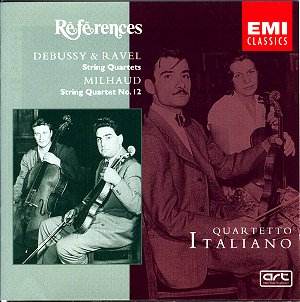
Darius Milhaud: String Quartet No. 12, Op. 252 / Claude Debussy: String Quartet in G minor / Maurice Ravel: String Quartet in F
Quartetto Italiano (Paolo Borciani and Elisa Pegreffi, violins; Piero Farulli, viola; Franco Rossi, cello)
Recorded in the Basilica, Milan — Debussy and Milhaud in January 1954 (mono), Ravel in 1959 (stereo)
EMI CDH5 74792-2 [ADD]; total playing time approx.
74 minutes* — Listening to this reissue of the Quartetto Italiano’s mid-century survey of French chamber music — — with Milhaud’s Twelfth Quartet anchoring the disc — is an experience tinged both with nostalgia and revelation. The Italian ensemble’s second line-up, in particular Piero Farulli’s warm and singing viola, breathes a distinctive Mediterranean sensibility into these Parisian-inflected works. Recorded in the cavernous, reverberant Basilica of Milan, the sound—mono for the 1954 sessions, stereo for Ravel’s 1959—is not without its historical limitations but offers — a vivid snapshot of an era when string quartets communicated with a blend of passion and restraint, unsullied by the hyper-polished precision we often expect today.
Milhaud’s String Quartet No. 12, Op. 252, written in 1945 to mark Gabriel Fauré’s centenary, is the disc’s real discovery.
This is music rarely plucked from obscurity, often overshadowed by Milhaud’s more dazzling polytonal experiments or his famed octet pairing of Quartets 14 and 15. Yet here, under the Italiano’s deft fingers, it is strikingly accessible. The opening "Allegro" is sunlit and — well — sanguine—a mosaic of tuneful motifs that flow with — an almost pastoral ease, far from the harsher edges sometimes associated with Milhaud’s output.
Farulli’s viola punctuates the texture with an intimate, almost conspiratorial warmth, while Borciani and Pegreffi’s violins dance lightly but never lose focus. The resulting sound is neither dense nor overburdened, but transparent and clear, the kind of chamber music that invites you close, to listen for the quiet interplay of lines, the subtle shifts in tonal color and rhythmic syncopation. The Lento second movement offers a remarkable contrast: hushed, almost whispered, it feels like an intimate nocturne.
The players’ bowing is feather-light here, the cello’s line a deep and tender murmur beneath the shimmering upper strings. It’s a movement that depends on exquisite control and — well — sensitivity, which the Quartetto Italiano possess in spades. The final movement, marked ‘avec entrain,’ bristles with kinetic energy—foot-tapping rhythms propel it forward, and yet there is an inventive looseness that never sacrifices rigor.
The leader’s presence feels palpable even in this studio setting.
You feel the players reveling in Milhaud’s rhythmic inventiveness, occasionally pushing the tempo just enough to keep the momentum fresh and exciting. Turning to the Debussy and Ravel quartets, it’s impossible not to admire the Italiano’s musicianship—decades before the Alban Berg Quartet’s legendary later recordings, these performances carry a compelling freshness. The Debussy, recorded in 1954, is a masterclass in clarity and rhythmic vitality.
The second movement pizzicati are truly guitar-like, crisp and infectious—there’s a sense here not of mechanical precision but of organic flow, the pizzicato notes plucked with a natural bounce and lightness, almost a nimble dance. The "finale"’s rhythmic drive is taut and exhilarating; the ensemble breathes together with such unanimity that the music’s delicate tension builds effortlessly. This is not a slow, languorous Debussy but one imbued with a clean, almost architectural clarity.
Ravel’s quartet, caught in stereo five years later, is equally impressive. The second movement stands out for its captivating sense of atmosphere—riveting, really. The players seem to inhabit Ravel’s rarefied sound-world as if they were born there, their tone immaculate yet warm, their intonation impeccable.
The subtle shifts in texture—so crucial in Ravel’s writing—are rendered with a shimmering finesse. Here, the Quartetto Italiano’s fluid sense of rhythm proves invaluable, allowing phrases to breathe naturally, avoiding both stiffness and excess rubato. Their collective control over dynamic nuance, the subtle gradations from pianissimo to sudden bursts of intensity, is exemplary.
One could quibble with the occasional dryness in the higher registers—possibly a product of the release conditions rather than the playing—but such quibbles pale against the overall artistry on display. This is chamber music of a kind that rewards repeated listening: not merely for the music’s inherent charm but for the way the Quartetto Italiano exemplifies the ideal balance between intellectual rigor and emotional engagement. In sum, this EMI reissue is more than a period curiosity.
It is a vital document of Milhaud’s lesser-known chamber music and an eloquent expression of mid-20th-century string quartet artistry. Whether you are drawn by the Debussy, the Ravel, or—crucially—by Milhaud’s Twelfth Quartet, you will find here performances that combine clarity, warmth, and rhythmic finesse. Collectors and newcomers alike should consider it a worthy addition to their shelves.
For those seeking a complementary Milhaud experience, the Parisii String Quartet’s survey (Auvidis V4781) offers a useful contrast—more modern in sound, more exploratory in temperament—yet the Italiano’s performances remain a benchmark of classical poise. Decisively: this disc rewards the patient listener with its unassuming yet deeply satisfying performances. The Quartetto Italiano’s mid-century vision of French chamber music stands undiminished, a testament to their enduring artistry and the timeless appeal of these works.