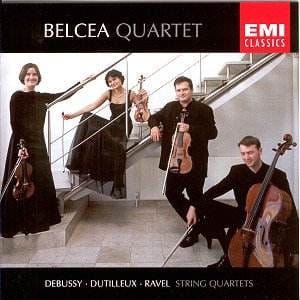
Belcea String Quartet
Debussy String Quartet in G minor, Op. 10 / Dutilleux Ainsi la nuit / Ravel String Quartet in F Recorded May 2000, Potton Hall, Suffolk (DDD) EMI CDZ574020-2 [71:16]; The Belcea Quartet’s debut disc, recorded in a modest hall tucked away in Suffolk, announces a fresh voice in a crowded field. This ensemble, forged at London’s Royal College of Music in 1994, and already decorated with prestigious competition prizes (Osaka, Bordeaux, and the Royal Philharmonic Society’s Chamber Ensemble Prize), brings an intriguing blend of youthful vigour and polished poise to these canonical French quartets, with a twentieth-century jewel nestled between.
The coupling of Debussy’s String Quartet and Ravel’s String Quartet is well-trodden ground; yet the Belcea’s approach — particularly with the Dutilleux Ainsi la nuit — lends this disc an essential point of distinction. One senses immediacy and intimacy in their sound, a quality often sacrificed in the quest for sheer precision or the brashness of youthful bravura. The opening of Debussy’s quartet unfolds with a springing vitality, yet also a nuanced lightness that avoids the common pitfall of over-emphasis on languor or impressionistic haze.
The first movement’s shifting textures breathe with a supple, almost whispered elasticity — a delicate dance of bow pressure and vibrato that seems to caress rather than seize the frail motifs. The slow movement, by contrast, feels the quartet’s true home. Here, in its desolate calm — the four instruments coalesce into a shimmering stillness that seems to suspend; time — an aural chiaroscuro where each pizzicato and subtle dynamic fluctuation is weighted with expressive intent.
Their handling of the "scherzo" is notably spirited: the gamelan-inspired pizzicati dance with an infectious energy, youthful but never careless, capturing Debussy’s evocation of exotic timbres with remarkable clarity. The Ravel quartet, lighter in texture and more classical in its formal clarity, is approached with a charming spontaneity. The opening gesture gives an illusion of improvisation — a ‘spur-of-the-moment’ air — but one quickly realises the architecture is firmly in place beneath.
The Belcea’s sensitivity to instrumental colour allows them to navigate the second movement’s frequent shifts of mood effortlessly, while the slow movement’s tenderness recalls the same intimate expressiveness found in Debussy’s "Adagio". But where this disc truly stakes its claim is in the Dutilleux. Here, the ensemble’s collaboration with the composer himself reveals a rare authority and insight that outshines many more seasoned quartets.
Ainsi la nuit (composed 1973–76) is a notoriously demanding work — its elusive harmonies and — elusive textures require not just technical finesse but a deep immersion in its sound world. The Belcea Quartet achieves this with an almost breathless stillness in moments of stasis and a crystalline transparency in its more intricate passages. Their rendition is a study in concentrated listening: every whisper of arco or sul ponticello, every shade; of dynamic nuance, unfolds with deliberate attention — a testament to their commitment to the composer’s intentions.
This is music that demands full engagement; the quartet meets this challenge head-on, their rendering rivalled only by the great Arditti Quartet’s Montaigne production. This disc arrives in the shadow of recent releases by the Alban Berg and Quartetto Italiano — formidable benchmarks for Debussy and Ravel. Yet, the Belcea Quartet holds its own with a distinctive blend of vibrant freshness and mature interpretative insight.
Their collective sound is neither over-polished nor raw; instead, it strikes a tender balance, with a warmth and — well — immediacy that invites repeated listening. In sum, this debut offers more than promise: it is the flowering of a quartet whose well-judged repertoire choices and meticulous musicianship forecast a bright future. An unhesitating recommendation — especially for those who treasure the subtle interplay of — colour, texture, and expressive nuance that these French masterpieces—and Dutilleux’s enigmatic masterpiece—demand and deserve.