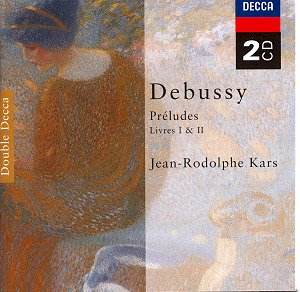
Claude Debussy: Préludes (Complete); Fantaisie pour piano et orchestre
Olivier Messiaen: Regards de l’Enfant-Jésus (Regard de l’Esprit de joie, Regard du silence), Catalogue d’oiseaux, Livre 1 – “Le Merle bleu”
Jean-Rodolphe Kars (piano), London Symphony Ensemble / Alexander Gibson
Recorded 1968–71: Préludes at St John’s, Smith Square; Fantaisie at Kingsway Hall; Messiaen works at Decca Studio No.3, West Hampstead
Decca (originally), reissued by DG, double disc [140:58]
Jean-Rodolphe Kars’s 1970s recordings of Debussy and Messiaen, newly reissued, invite a fresh look at a pianist who, though never quite a household name, embodies a particular school of French pianism—one marked by crystalline pedal control and a certain probing delicacy. His Préludes now sit uneasily alongside the better-known Michel Béroff or even the epochal Gieseking, whose 1950s versions remain a lodestar. Yet Kars’s readings breathe with a distinct personality—fragile but never tentative.
Take “La Cathédrale engloutie”: Kars conjures a misty, almost spectral atmosphere with his pedal, shrouding the sonorities in a gauzy haze that perfectly captures Debussy’s evocation of submerged ruins. Still, the tension at the climactic ascent doesn’t quite hold; the momentum wavers—just a little—before the cathedral’s full majesty is revealed. Contrast this with his approach to “Puck”—here, the staccato is crisply offhand, capricious, light as a butterfly, the horn calls colorfully sketched, almost teasing.
It’s a vivid microcosm of Debussy’s palette—elusive but pointed. Kars’s touch reveals itself most strikingly in the virtuosic passages of “Les fées sont d’exquises danseuses,” where fingerwork dances with an exquisite precision that also manages to feel spontaneous. “Canopes” glimmers with carefully placed chords, like jewels scattered across an Egyptian tableau.
Oddly enough, “Feux d’artifice,” that firework display of sound and texture, here feels a touch restrained—controlled to a fault, as if Kars were holding back the full pyrotechnics. One would expect the Préludes’ tempestuous miniatures to bristle with unrelenting energy, but Kars chooses instead a nuanced chiaroscuro, a subtle play of light and shadow. This sometimes pays dividends—the “Sérénade interrompue” emerges with a nuanced guitar-like timbre, capturing the elusive Serenade’s languid pulse.
But in “Minstrels,” the realization is less convincing, failing to catch the tumbling, slapstick-like gestures that Debussy so slyly sketches. At the heart of this collection lies a fascinating intertextuality: Kars’s reading of “La terrasse des audiences du clair de lune” is charged with an almost Messiaen-esque sensibility—sensual, hypnotic, forward-leaning in a way that anticipates his handling of the Regards de l’Enfant-Jésus and Catalogue d’oiseaux. These Messiaen selections, chosen with care, reveal a pianist attuned to the composer’s spiritual intensity and complex sonorities.
“Regard du silence”—fragile, hushed—is a study in restraint, whereas Le Merle bleu unfolds over fifteen compelling minutes, balancing bird calls and — well — ethereal harmonies with rapt concentration. Within this arc of sound, Kars reveals the subtle Debussian threads woven into Messiaen’s — harmonic fabric—around the five-minute mark, one hears a clear nod back to Debussy’s sensibility. The Fantaisie for piano and orchestra, too, deserves special mention.
Often overshadowed by Debussy’s piano miniatures, it receives here a reading of real depth and expressivity. The "Largo" e molto espressivo introduction to the second movement breathes with a tender lyricism, while the later "Allegro" molto passages display incisive rhythmic drive and clarity of articulation. Kars’s craft—flawless and flexible—handles these contrasting moods with aplomb, and the London Symphony under Alexander Gibson offers a supportive, well-balanced partnership.
The sound, captured in various London venues and studios, is clear and immediate, with an intimacy that draws you close to the piano’s nuanced colours. Of course, this release isn’t without its flaws. The occasional lapses in momentum, most notably in the Préludes’ more dramatic moments, suggest a performer perhaps prioritizing clarity over sheer emotional sweep.
But this very quality—an emphasis on detail, tonal subtlety, and — well — pedal nuance—makes Kars’s account a worthwhile counterpoint to more overtly romantic or weighty interpretations. In the rich discography of Debussy, this DG reissue of Kars’s recordings stands as a quietly compelling alternative. It complements rather than competes with the established canon, offering listeners a nuanced, occasionally enigmatic perspective that rewards patient, attentive hearing.
You can almost hear the rosin dust settling on the strings.
And for Messiaen devotees, these are performances of considerable stature—intimate yet radiant, scholarly yet deeply felt. In sum: not the definitive Préludes, but a version that will intrigue and enrich. Not the most dazzling Fantaisie, yet one of refined expressivity.
And a glimpse—through Messiaen’s prism—of the fascinating interplay between two of France’s greatest musical imaginations, captured by a pianist who knew how to listen as much as to play. Richard Dyer