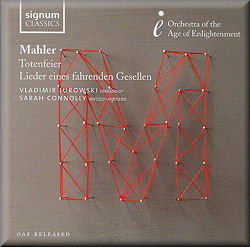
Gustav MAHLER Totenfeier / Lieder eines fahrenden Gesellen
Gustav Mahler (1860-1911)
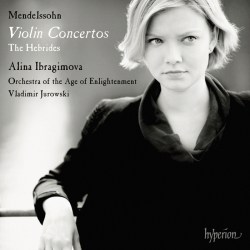
Sarah Connolly (mezzo), Orchestra of the Age of Enlightenment/Vladimir Jurowski
SIGNUM CLASSICS SIGCD259 (38:13)
Mahler was 28 when he wrote Totenfeier, and the music sounds like someone who has already stared into the abyss and found it staring back. The piece would eventually become the first movement of the Second Symphony — recomposed, refined, fitted into a larger eschatological drama — but heard alone, as Vladimir Jurowski and the Orchestra of the Age of Enlightenment present it here, it has a rawness that the symphony’s later context tends to smooth over. This is Mahler before he knew what he was doing. Which is to say: before the self-consciousness set in.
Jurowski, conducting period instruments, takes the opening pages at a pace that feels genuinely dangerous. The strings — gut-strung, leaner in body than a modern orchestra — cut rather than warm. The funeral march doesn’t console. It accumulates.
What period interpretation practice brings to Mahler is a question worth sitting with. The composer was, after all, a ferocious modernizer of the orchestra — he expanded it, weighted it, pushed dynamics toward the edges of the possible. Period instruments might seem an odd lens. But the OAE’s winds have a reedy particularity, a rawness of attack, that modern players trained toward blend and beauty tend to sand away. When the great climaxes arrive in Totenfeier, they arrive without cushioning. The brass cut. You wince. That seems right.
Lieder eines fahrenden Gesellen is another matter — or rather, an earlier matter. The cycle dates from around 1884, written in the miserable aftermath of Mahler’s infatuation with soprano Johanna Richter, who didn’t love him back. The texts are his own, fashioned loosely in the manner of Des Knaben Wunderhorn, and they have that particular quality of grief which is also a little self-dramatizing — young man’s grief, vivid and operatic. Sarah Connolly understands this. She doesn’t romanticize. She lets the words land.
Connolly’s mezzo has a specific gravity to it, a darkening at the center of the voice that suits Mahler’s chromatic wanderings. In “Wenn mein Schatz Hochzeit macht,” she captures the almost unbearable quality of the opening — the wedding is happening, the beloved is marrying someone else, the bluebell is ringing in the meadow — without pushing the sentiment. The grief is matter-of-fact, which makes it worse. In “Die zwei blauen Augen von meinem Schatz,” the final song, she finds a stillness that’s genuinely moving. Under a linden tree, the wayfarer finds rest. She sings it as if she believes it, which is the only way.
Competing versions are not scarce. Dietrich Fischer-Dieskau’s recordings — particularly those with Furtwängler and later with Kubelík — remain reference points, and there’s something irreplaceable in a baritone voice for music that imagines a young man’s anguish. But Connolly belongs in serious company. Her phrasing is intelligent, her German idiomatic, her dynamic control finely calibrated to what Jurowski’s textures can support. And those textures are often exquisite — the OAE strings in the second song shimmer without glittering, if that distinction makes any sense, which in this music it does.
The live album, taken from a January 2011 Royal Festival Hall concert, has the presence and mild unpredictability of a real event. You hear the silence before downbeats. The balance occasionally tips — winds forward, strings slightly recessed — but these are the textures of a room and an evening, not a studio’s approximation of one.
Decisive, then: this is a distinguished release. Not the last word on either work — there isn’t one — but a genuine contribution, alive to the strangeness of Mahler’s early voice and served by performers who trust that strangeness rather than prettifying it. Connolly and Jurowski are serious artists doing serious work. That’s rarer than it should be.