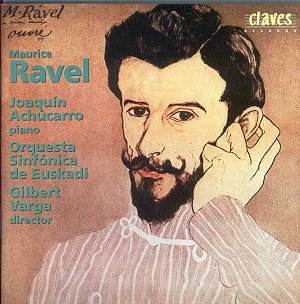
RAVEL Piano Concerto in G major / Piano Concerto for the Left Hand / Alborada del Gracioso
Maurice Ravel (1875-1937)
Joaquín Achucarro, piano; Euskadi Symphony Orchestra (Basque National Orchestra); Gilbert Varga, conductor
CLAVES CD 50-2101 (49.23)
The Ravel concertos attract pianists the way certain flowers draw particular insects—there’s something in the nectar. And the discography groans under the weight of fine recordings, from Michelangeli’s chiseled perfection to Argerich’s mercurial brilliance, from Rogé’s Gallic suavity to Thibaudet’s gleaming surfaces. So why another?
Well, because Joaquín Achucarro has something to say, and because the Euskadi Symphony Orchestra—the Basque National Orchestra, for those who don’t know that Euskera is the name of the language—brings a particular sympathy to music by a composer born in Ciboure, in the French Basque country. These aren’t negligible considerations, though whether they translate into musical illumination is another matter entirely.
The Concerto in G opens with that famous whipcrack, and immediately you notice Varga’s refusal to let the orchestral textures blur into prettiness. The woodwinds have bite—there’s real tang in the oboe’s contributions, and the trumpet (named in the liner notes, a nice touch) plays with just enough edge to suggest Harlem rather than the Ritz. Achucarro’s approach to the solo part is notably unsentimental. He doesn’t milk the jazz inflections, doesn’t turn them into exotic gewgaws for our delectation. The rhythmic spring in the outer movements feels natural, unforced, though I wanted more volatility in the first movement cadenza, more sense of improvisation pushing against the written notes.
But it’s the Adagio assai that proves problematic. Achucarro plays it with intelligence—he understands the harmonic implications, the way those cor anglais phrases hang suspended in mid-air. What’s missing is… well, magic. That quality of limpid lyricism that makes this movement one of Ravel’s most ravishing inspirations never quite materializes. The pianist seems almost wary of the music’s potential for sentimentality, and in protecting himself from excess he denies us rapture. I kept thinking of Marguerite Long’s account of Ravel at the premiere, how he wanted the slow movement to sound like Mozart. Achucarro gives us clarity, radiant voicing, attention to inner lines—everything except that sense of time suspended, of melody unfolding with the inevitability of dawn.
The finale fares better. Here Achucarro’s rhythmic precision serves the music well, and there’s some genuinely blowsy, bluesy woodwind playing that captures Ravel’s sophisticated nostalgia for American jazz. The orchestral execution is first-rate throughout—these players clearly know this music, live with it.
The Concerto for the Left Hand suits Achucarro’s temperament more completely. This darker, more ambiguous work doesn’t invite the kind of lyrical surrender that the G major’s slow movement demands. The pianist catches the music’s fragmentary quality, its refusal to settle into comfortable patterns. Written for Paul Wittgenstein (who lost his right arm in the Great War), the concerto carries shadows that Achucarro doesn’t try to dispel. His left hand negotiates the virtuoso demands with admirable security—there’s never a sense of strain, even in the most taxing passages. And he understands how Ravel fuses jazz elements with something closer to genuine mourning, how those final cadences suggest not triumph but exhaustion, perhaps even despair.
Varga conducts with particular sensitivity here. The orchestral interjections have weight without bombast, and the long build to the final climax is carefully judged. The Euskadi players produce a darker, more velvety string tone than in the G major—whether by design or happy accident, it suits the music’s character.
Alborada del Gracioso, Ravel’s 1919 orchestration of the piano piece from five years earlier, serves as interlude. It’s brilliantly done—all that Spanish color, those castanets and tambourines, the orchestral virtuosity that Ravel commanded so effortlessly. The rendition here is vivid, charged, though perhaps a touch careful. I wanted more abandon in the central section, more genuine wildness.
The recorded sound, captured in San Sebastián’s Miramon, is detailed without being clinical. You can hear individual strands in Ravel’s orchestration, which is essential in this music. The piano sound is natural, well-integrated with the orchestra.
So where does this leave us? With a recording that offers genuine insights, particularly in the Left Hand Concerto, but that doesn’t quite scale the heights in the more popular G major. Achucarro is a serious artist—that’s evident in every measure—and the Euskadi Orchestra plays with distinction. But in a crowded field, I’m not sure this displaces Rogé with Dutoit, or Zimerman’s disc with Boulez, or several others that bring more individual personality to this music.
Still, there’s integrity here, and musical intelligence. Sometimes that’s enough.