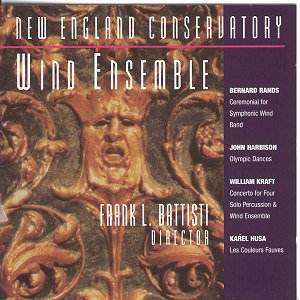
Bernard RANDS (born 1934)
Ceremonial (1992)
John HARBISON (born 1938)
Olympian Dances (1997)
William KRAFT (born 1923)
Concerto for Four Solo Percussion and Wind Ensemble (1964, arr. 1995)a
Karel HUSA (born 1921)
Les Couleurs Fauves (1995)
Matthew Manturuk, Eric Millstein, John Tanzer, Scott Vincent (percussion)a;
New England Conservatory Wind Ensemble; Frank L. Battisti
Recorded: Jordan Hall, Boston, February 1998 (Rands, Harbison); February
1997 (Kraft, Husa)
ALBANY TROY 340 [65:41]
The wind ensemble—long the poor relation in American conservatory training—has lately been attracting some first-rate compositional attention, and this Albany disc offers persuasive evidence. Frank Battisti, who spent three decades building Ithaca College’s wind program into something formidable, here leads the New England Conservatory forces through four substantial works that take the medium seriously.
Bernard Rands’s Ceremonial opens the program with characteristic intelligence. Rands, who won the Pulitzer for Canti del Sole back in 1984, writes with a fastidiousness that can sometimes feel overly cautious—but not here. The piece unfolds in overlapping panels of color, the winds darkening and brightening in subtle gradations. There’s a passage about four minutes in where the brass chorale emerges from what sounds like wind rushing through trees… or maybe I’m being fanciful. The NEC players navigate Rands’s meticulously notated dynamics with real sensitivity, though I wished for more bite in the climactic pages.
John Harbison’s Olympian Dances proves less Olympian than one might expect—this is no Sacre, thank goodness. Harbison, always the most urbane of the Boston composers, offers seven brief movements that wink at the notion of athletic grandeur while maintaining his signature ironic distance. “Aphrodite” floats along on paired flutes; “Apollo” struts with predictable swagger. The charm lies in Harbison’s refusal to be seduced by his own conceits. Each dance lasts just long enough, then exits before wearing out its welcome. Smart writing.
William Kraft’s Concerto for Four Solo Percussion represents the disc’s central attraction, and the four young percussionists—Manturuk, Millstein, Tanzer, and Vincent—attack it with fearsome precision. Kraft, himself a percussionist who spent years with the Los Angeles Philharmonic, knows exactly what he’s doing. The 1964 original was for orchestra; this 1995 wind arrangement (by the composer) actually clarifies the textures. You hear everything.
The outer movements crackle with rhythmic vitality, all those cross-rhythms snapping into place like tumblers in a lock. But it’s the central Adagio that stays with you—bowed vibraphone against sustained wind chords, creating an otherworldly shimmer. The soloists play as a genuine quartet here, listening, responding, breathing together. One wishes the recording had captured a bit more hall ambience; Jordan Hall’s warmth gets somewhat flattened in the engineering.
Karel Husa’s Les Couleurs Fauves closes the program with appropriate weight. Husa, now in his late seventies when this was recorded, had long since proven himself one of the wind band’s most important advocates—his Music for Prague 1968 remains a cornerstone of the repertoire. This 1995 work, commissioned by Battisti himself, shows the composer’s powers undiminished.
The title evokes those wild beasts of early French modernism, and Husa delivers accordingly. Savage brass fanfares, woodwinds shrieking in their upper registers, percussion battering away at the foundation—yet the architecture remains audible throughout. Husa constructs his climaxes with an experienced hand; you feel them building from deep in the structure rather than being merely plastered on top. The NEC ensemble sounds slightly overwhelmed in the most ferocious passages, but who wouldn’t be? This is music that demands everything.
Battisti’s direction throughout proves exemplary—clear, shapely, never indulgent. He understands that wind ensemble music lives or dies by balance and color, and he’s coaxed both from these young players. The disc, made over two sessions in 1997 and 1998, sounds decent if not spectacular. Albany’s production values remain workmanlike.
This is a valuable disc. Not every piece here qualifies as a masterwork, but each represents serious compositional engagement with a medium that still struggles for respect. The performances honor that seriousness without pomposity. Recommended, particularly for those who persist in thinking the wind ensemble can’t handle real music.