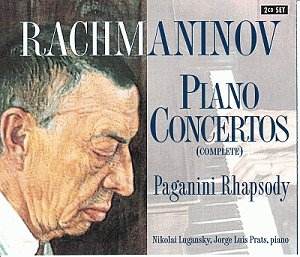
RACHMANINOV Piano Concertos Nos. 1-4; Rhapsody on a Theme of Paganini
Sergei Rachmaninov (1873-1943)
John Lill (piano), BBC National Orchestra of Wales, Tadaaki Otaka (conductor); Jose Luis Prats (piano), Mexico City Philharmonic Orchestra, Enrique Batiz (conductor); Nikolai Lugansky (piano), State Academy Symphony Orchestra of Russia, Ivan Shpiller (conductor)
BRILLIANT CLASSICS 6214 (75:03; 78:34)
The super-budget labels have become something of a lottery. You pays your money—sometimes astonishingly little of it—and you takes your chances with performances that range from revelatory reissues to recordings one suspects were made primarily to fill catalog space. This Brilliant Classics survey of Rachmaninov’s concerted works falls somewhere in the middle, though it tilts decidedly toward the worthwhile.
What strikes me first is the sheer abundance of the competition. We live in a golden age for Rachmaninov on disc, perhaps because these works have never fallen from public favor, unlike so much of the repertoire that requires periodic rehabilitation. From the composer’s own magisterial recordings—now beautifully remastered on Naxos—through Ashkenazy’s various traversals (the Decca Double with Previn remains a cornerstone), to Earl Wild’s phenomenal pianism with Horenstein on Chandos, the collector faces an embarrassment of riches. Add Bernd Glemser’s surprisingly successful Naxos cycle, Zoltan Kocsis on Philips, even Martino Tirimo’s workmanlike CFP set, and one wonders: does the world need another complete Rachmaninov?
The revelation here—and I don’t use that word lightly—is John Lill’s account of the Piano Concerto No. 1. This early work, revised substantially by the composer in 1917, often gets treated as apprentice Rachmaninov, all Tchaikovskian bluster and salon sentiment. Lill will have none of it. His reading discovers genuine poetry in the youthful score, a darker introspection beneath the bravura that points forward to the mature masterpieces. The finale has always been treacherous territory—that barnstorming opening too easily becomes mere noise, and when the great lyric theme emerges (around 2’15” in this performance), pianists often slather on the schmaltz. Not Lill. He shapes the phrase with aristocratic restraint, and Otaka and the BBC National Orchestra of Wales respond with playing of real sensitivity. The Nimbus recording captures both the piano’s warmth and the orchestra’s detailed textures; you can hear the woodwind solos breathe. I’m aware that some critics found Lill “too hard, too Lisztian” on this disc’s first release, but I confess I don’t hear it. What I hear is a pianist who understands that even young Rachmaninov was never merely sentimental.
The Russian contributions—Lugansky in the Third and Fourth Concertos—present a classic case of brilliant soloist, adequate orchestra. And “adequate” may be generous. Lugansky himself plays like a young god; this is red-blooded Russian pianism of the old school, the kind that makes you think of Richter in his prime or the young Gilels. In the Third Concerto, he chooses the first-movement cadenza Rachmaninov himself preferred—the shorter, more concentrated one—rather than the alternative that sounds like it wandered in from a Liszt rhapsody. His fingers negotiate the treacherous passagework with ease, but more importantly, he finds the architecture in this massive structure, the long lines that prevent it from collapsing into a series of virtuoso episodes.
The problem is the State Academy Symphony Orchestra of Russia under Ivan Shpiller. This appears to be a Vanguard original, and the sound doesn’t help—it’s thin, lacking the body and bloom one expects in Rachmaninov. But the real issue is the playing. That “authentic” Russian vibrato on the horn—we’ve all made our peace with it by now—here becomes almost a wobble in the finale’s big tune. The strings lack the opulence, the sheer tonal luxury that Svetlanov’s generation produced seemingly without effort. It’s serviceable accompaniment to extraordinary solo playing, which is frustrating. The Fourth Concerto, that much-maligned score (revised obsessively by its creator), receives a performance of similar strengths and weaknesses. Lugansky makes the strongest case I’ve heard for the work’s rehabilitation, but the orchestra merely trudges along.
Then there’s the Latin American contingent: José Luis Prats and the Mexico City Philharmonic under Enrique Bátiz in the Second Concerto and the Paganini Rhapsody. I’ve always found Bátiz’s recordings worth investigating—there’s a Copland disc from these forces that still thrills—and he certainly generates excitement here. Listen to the coda of the concerto’s finale, where the orchestra plays as if its collective life depends on it. The energy is palpable.
But… there are problems. Intonation turns sour in spots. Ensemble gets scrappy. The famous eighteenth variation of the Rhapsody—that gorgeous inversion of Paganini’s theme—suffers from both sins, though not enough to derail the rendition entirely. Prats himself acquits himself honorably; he’s a genuine pianist, not just a technician, and he seems to relish Bátiz’s relatively swift tempos, which give these familiar works a certain freshness, a no-nonsense directness that’s appealing even when it’s not wholly idiomatic.
A word about the presentation, or lack thereof. Brilliant Classics continues its maddening habit of providing virtually no documentation—no notes, no context, just the bare facts. And the track spacing is absurdly brief; movements run into each other with unseemly haste. These are penny-wise, pound-foolish decisions that diminish an otherwise respectable release.
So where does this leave us? No serious collector will be without these works in multiple versions—they’re too central to the repertoire, too beloved. But if you spot this set in one of the high street chains (I’ve seen Brilliant Classics discs for as little as two quid), it’s worth considering, primarily for Lill’s First Concerto and Lugansky’s solo work in the Third and