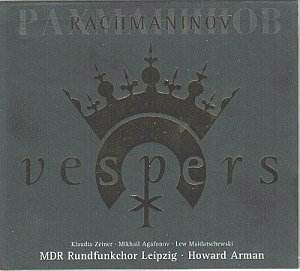
RACHMANINOV Vespers Op. 37 All-Night Vigil
Sergei Rachmaninov (1873-1943)
Klaudia Zeiner (alto), Mikhail Agafonov (tenor), Lew Maidatschewski (lector), MDR Rundfunkchor Leipzig, Howard Arman
BERLIN CLASSICS 0017422BC (74:36)
The English-speaking world persists in calling this work the “Vespers“—a convenient misnomer that obscures what Rachmaninov actually achieved. The All-Night Vigil encompasses Vespers, Matins, and the First Hour of Orthodox liturgy, a tripartite structure that unfolds across nearly an hour and a quarter of some of the most demanding choral writing ever committed to paper. Written during a 1915 concert tour—imagine composing this amid the chaos of wartime travel—the work received its premiere that March with the Moscow Synodal Choir under Nikolai Danilin. Four additional performances that season. The Moscow public knew what it had heard.
Howard Arman and his Leipzig forces understand it too. This is choral singing of the first rank, and I’ll say immediately that it stands with the finest recordings in a crowded field. The competition includes everything from the St. Petersburg Cappella under Chernushenko (authentically Russian but occasionally wayward in pitch) to Matthew Best’s Corydon Singers on Hyperion (impeccable intonation, perhaps a shade too controlled). The Leipzig choir splits the difference and then transcends it.
Those legendary low notes—Rachmaninov knew his countrymen’s voices, he insisted, and what he could demand of Russian basses. The “Nyne otpushchayeshi” (Nunc Dimittis) descends to B-flat below the bass staff, and low C’s populate the score like Orthodox crosses dotting the landscape. When colleagues questioned where such singers could be found, the composer’s reply was characteristically blunt. Well, the Leipzig basses deliver. That fifth movement, which Rachmaninov himself cherished above the others, emerges here with a sepulchral depth that never loses focus or turns muddy. The sound is dark—properly dark—without sacrificing clarity.
Arman’s conducting shows real intelligence. He gives the music its necessary weight (this choir is larger than Best’s ensemble, and you hear the difference) while maintaining the kind of pitch security that eludes even some Russian choirs. Listen to the tenth movement, “Veneration of the Cross“—those chant-derived textures that mimic the tolling of great bells. The Leipzig choir achieves something remarkable here: a timbre that suggests Slavic tradition without imitating it, darkness without affectation.
The soloists present a mixed picture. Klaudia Zeiner’s alto has that operatic fullness critics often complain about in this repertoire—I’m adding my voice to that chorus, though her Russian diction is authentic enough. Mikhail Agafonov’s tenor contributions are undermined by pitch problems that shouldn’t have survived the editing process. But then there’s Lew Maidatschewski.
His inclusion as lector transforms the recording. These chant-like interpolations—similar in function to Anglican services but sounding wonderfully, irreducibly Russian—add a liturgical authenticity I hadn’t encountered on disc before. Maidatschewski’s bass voice has the requisite depth and darkness, and his presence makes the whole enterprise more convincing, more moving. It’s the difference between a concert rendition and something approaching the vigil’s actual function.
The recorded sound, captured in the Paul-Gerhardt-Kirche, finds the right balance. Enough resonance to place this music in its proper acoustic frame, not so much that textures blur or lines disappear. Berlin Classics has made an intelligent attempt to escape the jewel case tyranny—the presentation feels considered. Notes are concise, texts and translations included.
This is a major achievement. The Leipzig choir’s combination of technical security, timbral richness, and interpretive understanding places this disc at the top of a distinguished field. With Maidatschewski’s liturgical contributions adding a dimension the competition lacks, this All-Night Vigil deserves the strongest possible recommendation.