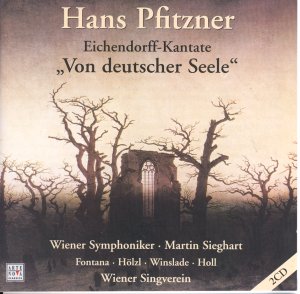
Hans PFITZNER (1869-1949) Von Deutscher Seele – Eichendorff-Kantate (1921)
Hans Pfitzner (1869-1949)
Gabriele Fontana (sop), Barbara Hölzl (mezzo), Glenn Winslade (ten), Robert Holl (bass), Anton Holzapfel (organ), Wiener Singverein/Johannes Prinz, Wiener Symphoniker/Martin Sieghart
ARTE NOVA 74321 79422 2 (CD1: 48.45; CD2: 50.31)
PFITZNER’S SOUL-SEARCHING
Hans Pfitzner’s Von Deutscher Seele, that sprawling, problematic monument to post-Versailles wounded pride, doesn’t come before the public nearly often enough—and when it does, the results are mixed. This Arte Nova set, captured live in the Musikverein in November 1999, offers Martin Sieghart and his Viennese forces in music that demands not just technical prowess but a willingness to believe in romantic affirmation when history has made such belief almost impossible.
The work itself—twenty-three Eichendorff settings stitched together into a nearly hundred-minute cantata—is nobody’s idea of a easy sell. Pfitzner composed it in 1921, when the rituals of humiliation inflicted by the Treaty were still fresh wounds, and you can hear that tension throughout: eerie consolation butting up against nightmare visions, self-effacing optimism trying to burgeon in spite of obliterated certainties. It’s Schubert and Schumann filtered through Mahler’s anxieties, with trumpet calls that sometimes sound less like affirmation than desperate bravado.
Sieghart understands this ambivalence. His pacing in the long first section, “Mensch und Natur,” allows the music to breathe without losing narrative thread—no small achievement when individual songs must cohere into something larger. The Vienna Symphony plays with considerable beauty in the orchestral interludes, particularly the flute tracery in “Ergebung” (CD2, track 3), where the instrumental writing achieves that Pfitznerian blend of late-romantic richness and chamber-like transparency. The harp, so crucial to this score’s timbral palette, emerges with proper prominence.
But live performance exacts its price. Gabriele Fontana’s soprano, while musicianly, lacks the radiant ping that Agnes Giebel brought to the DG album under Keilberth—still, after all these years, the benchmark. When Pfitzner asks the soprano to ring out over those great blasts of sound at work’s end, Fontana gets there, but the effort shows. More troubling is Robert Holl’s bass in “Gleich wie auf dunklem grunde” (CD2, track 5): the wobble that mars his tone here would be forgivable in a septuagenarian, less so in a singer who should be in his prime. Otto Wiener on that DG set—now there was steadiness married to interpretive depth.
Glenn Winslade’s tenor fares better, though he can’t match Josef Protschka’s ringing authority on the Koch Schwann set under Hollreiser. Still, Winslade brings valiant tone to “Wir wandern,” where the Vienna Symphony’s trumpets screech toward heaven with an almost desperate intensity. You hear in those brass outbursts something of what Pfitzner was after: not mere nationalism (though God knows that’s in there too) but something closer to existential defiance.
The mezzo Barbara Hölzl proves the most consistent soloist, her dusky tone particularly effective in the second disc’s “Leben und Singen” section. The Wiener Singverein, prepared by Johannes Prinz, sings with that blend of precision and warmth you expect from this ensemble—lovely soft singing in “Von allen guten schwingen,” proper bite in the more martial moments.
Sieghart’s real achievement lies in laying bare what one might call the German lyric soul without sentimentalizing it. He finds the Korngoldian tenderness in “Die Friedensbote” (CD2, track 11) at the words “Rauschen die quellen herein,” moderating the movement’s rhodomontade with genuine feeling. And in “Tod als Postillon,” that macabre Dürer-spirited nightmare, he points up the Mahlerian connections (think Das klagende Lied) while maintaining Pfitzner’s distinctive voice—that long German nightmare tradition running from Schubert’s “Erlkönig” through Raff and Liszt forward to Franz Schmidt’s apocalyptic visions.
One wishes Arte Nova had achieved better quality control: a premature cymbal stroke mars the end of CD1, track 11, and the occasional cough (inevitable in live rendition, I know) proves distracting. More seriously, the sound picture, while vivid, doesn’t quite match the DG’s studio clarity or the Koch’s outstanding combination of color and depth. The decision to track individual songs helps immeasurably—the Koch set’s single-track-per-disc approach was maddening.
Still, at bargain price for two discs, this represents a valuable addition to Pfitzner’s slim discography. Sieghart conducts with genuine feeling and considerable intelligence. The Vienna forces play as if they believe in this music, which matters more than one might think. That final “Schlussgesang,” with its clamorous victory and vaulting tone, its boastfulness softened by those redemptive words about stars steering us home—well, Sieghart makes you believe it, at least for the moment.
The field remains uncrowded: DG’s Keilberth still leads for sheer vocal glory (Wunderlich!), Koch’s Hollreiser for interpretive depth. But Sieghart deserves hearing. One cherishes hopes he might turn his attention to Pfitzner’s Das dunkle Reich, or perhaps those Joseph Marx songs with orchestra. Meanwhile, this Von Deutscher Seele offers soul-searching of a high order—blemishes and all.