PERI Euridice
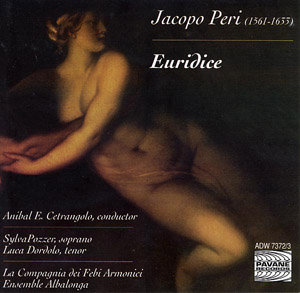
Jacopo Peri (1561-1633)
Sylva Pozzer, soprano (Euridice); Luca Dordolo, tenor (Orfeo); Mirko Guadagnini, tenor; Alessandro Gargiulo, tenor; Maria Antonietta Piavan, soprano; Alessandro Carmignani, tenor; Bianca Simone, mezzo-soprano; Luca Ferracin, bass; Matteo Zenatti, tenor; Loredana Putzolu, mezzo-soprano; Marisa Pugina, soprano; Chiara Drago, soprano; Antonio Domenighini, baritone; La Compagnia dei Febi Armonici; Ensemble Albalonga; directed and conducted by Anibal E Cetrangolo
PAVANE ADW 7372/73 (116.47)
The First Opera, Unearthed
Peri’s Euridice, premiered in Florence in 1600 as part of the festivities surrounding the marriage of Henri IV and Maria de’ Medici, occupies that peculiar position in music history where scholarly significance threatens to overwhelm aesthetic pleasure. The earliest opera to survive complete—predating Monteverdi’s Orfeo by seven years—it represents the Florentine Camerata’s ambitious attempt to resurrect what they imagined was ancient Greek drama. Whether they succeeded in that archaeological fantasy is debatable. What they created was something stranger and more fragile.
This 1995 disc from Anibal E. Cetrangolo and his period forces offers us the work in what sounds like remarkably honest circumstances—recorded in a Paduan church with period instruments and a cast that seems to understand the music’s odd, ritualistic character. The acoustic is warm but not overly reverberant, allowing Peri’s spare textures to speak without apology.
The music itself unfolds with a deliberateness that modern ears may find challenging. Peri’s recitative—or stile rappresentativo, as the Florentines called it—moves in what often feels like suspended animation, the vocal line tracing the inflections of Italian speech while the basso continuo provides harmonic punctuation rather than propulsion. There are moments of genuine beauty: Orfeo’s lament “Non piango e non sospiro,” where Luca Dordolo’s tenor navigates the melodic arabesques with touching simplicity, or Euridice’s brief appearances, which Sylva Pozzer invests with a pale, otherworldly quality appropriate to a character who spends most of the opera dead.
Dordolo proves the disc’s most valuable asset. His voice has that slightly nasal focus that works beautifully in early Baroque repertoire—he sounds like he’s singing through the mask in the best sense, with clear diction and an understanding that Peri’s declamation requires subtlety rather than rhetoric. When the text turns pastoral, as in “Gioite al canto mio,” he finds the right balance between courtly restraint and genuine feeling.
The supporting cast navigates Peri’s idiom with varying degrees of success. Mirko Guadagnini and Alessandro Gargiulo handle their messenger and shepherd roles competently, though one wishes for more differentiation in vocal color. The women of the chorus—Maria Antonietta Piavan, Bianca Simone, Loredana Putzolu, and the others—blend nicely in the madrigalian choruses that punctuate the drama, those moments where Peri allows himself something closer to traditional polyphony.
La Compagnia dei Febi Armonici and Ensemble Albalonga play with period sensibility, though the continuo realization occasionally feels timid. One longs for more improvisatory daring, more rhetorical boldness in the chitarrone and theorbo lines. The strings in the brief instrumental sections have proper gut-string astringency without sounding undernourished.
The real question with Euridice isn’t whether it’s a masterpiece—it isn’t, not by the standards Monteverdi would establish just a few years later. The question is whether it still has something to tell us beyond its historical importance. Cetrangolo seems to believe it does, and this performance makes a decent case. There’s a ceremonial gravity to the proceedings, a sense of participating in something ritualistic rather than dramatic in the modern sense. Peri’s Orpheus doesn’t descend to the underworld; instead, death and resurrection happen offstage, reported by messengers. The opera exists in a kind of eternal present tense, a series of tableaux vivants held together by the thread of recitative.
The recorded sound is good if not spectacular—close enough to hear the singers’ breath, distant enough to preserve the church’s ambient warmth. Pavane provides adequate documentation, though one wishes for more detailed notes on interpretation practice decisions.
This is music that requires patience and a certain historical imagination. Unlike Monteverdi’s Orfeo, which leaps across the centuries with its theatrical vitality intact, Peri’s opera remains stubbornly of its moment—a fascinating artifact that occasionally flickers into life. Cetrangolo and his forces treat it with respect and affection, which is perhaps all one can ask. For scholars and early music enthusiasts, it’s essential. For general listeners… well, it’s worth hearing once, preferably with the libretto at hand and a willingness to meet the work on its own austere terms.