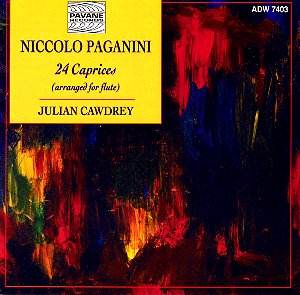
24 Caprices Op 1 arr Cawdrey
Niccolo Paganini (1782-1840)
Julian Cawdrey, flute
PAVANE ADW 7403 (77.34)
Paganini Without Strings
The hubris—or is it courage?—required to transcribe Paganini’s Twenty-Four Caprices for flute is considerable. These works exist in the violin’s DNA; they exploit every quirk and capability of gut and horsehair. Double-stops, string crossings, harmonics, those devilish left-hand pizzicatos—the whole arsenal of Paganini’s showmanship depends on the violin’s peculiar anatomy. Take that away and what remains?
Julian Cawdrey, the 1984 BBC Young Performer of the Year, has attempted an answer. His arrangement, recorded in a Gloucestershire church in 1997, joins a small fraternity of foolhardy flautists who’ve tackled this Everest. Patrick Gallois got there first on DG, deploying the full modern arsenal: circular breathing, flutter-tonguing, simultaneous humming. Jules Herman apparently made an attempt in the early seventies. Cawdrey takes a more conservative path, relying on what he calls “crisp articulation at fast tempi” and ingenious redistribution of the musical material.
The problems announce themselves immediately. In the Second Caprice, those scintillating semiquaver runs that a violinist can sustain almost indefinitely fracture into breath-interrupted fragments. It’s the flute’s Achilles heel—lungs need refilling, and Paganini wrote for an instrument that doesn’t. The melodic line keeps breaking. You notice it especially in the more lyrical caprices, where Paganini’s long-breathed cantabile gets punctuated by intrusive gasps.
Still, Cawdrey’s solutions show musical intelligence. The Sixth Caprice—that extraordinary study where the violin sustains a melody while simultaneously trilling—becomes a nuanced balancing act: he plays the melody with the trills pianissimo, an inventive if not entirely satisfying compromise. In the Eighth, where double-stopping is fundamental to the texture, he substitutes octave leaps. Does it work? Partially. The athletic quality remains, but something of the harmonic richness evaporates.
The Ninth Caprice, with its hunting-horn calls, fares better. Cawdrey uses grace notes to imitate the violin’s stopped notes, and here the flute’s brightness actually serves the music. There’s a frisky quality to his reading of the Twelfth—that drone-based study with its buzzing, folk-inflected melody. He leans into the rustic character, even if the sustained drone becomes a series of reiterated notes.
But the disc exposes limitations. A certain shrillness creeps into Cawdrey’s tone at the top of the compass—hardly surprising given the remorseless demands of this music, but the engineers at St. Andrews Church might have positioned their microphones more forgivingly. The Twenty-Second Caprice particularly suffers; what should glitter becomes strident.
The rhetorical Eleventh Caprice reveals both strengths and weaknesses. Cawdrey brings elegance to the melodic material—his phrasing is genuinely musical, not merely athletic. But the trills could be quicker, more incisive. They lumber slightly. And in the Fifteenth, those register leaps that violinists negotiate with a shift and a string crossing become awkward vaults on the flute. The line fractures. No amount of mastery can entirely bridge that gap.
One admires the project more than the result. Cawdrey plays with commitment and considerable skill—this is no vanity recording. His musical ear is acute; he avoids the worst incongruities, makes intelligent choices about transposition and ornamentation. The transcription itself shows craft and thought.
But finally, one wonders: why? Not every masterpiece needs translating. These caprices aren’t abstract études that happen to be written for violin; they’re violin music in the most essential sense. They think in terms of strings, bow, rosin, the peculiar resistance of horsehair against gut. Take that away and you have something interesting, occasionally impressive, but fundamentally compromised.
If you’re curious about the flute’s capabilities at their outer limits, this disc has value. Cawdrey certainly proves he can do it. Whether he should is another question entirely.