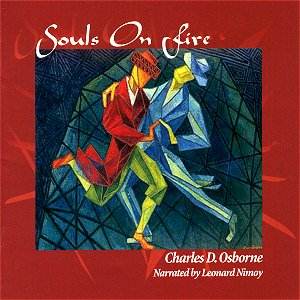
Charles D OSBORNE Souls on Fire
Charles D Osborne
Catherine Thorpe (soprano), Fredda Rakusin Mendelson (mezzo), Roger Ohlson (tenor), Wesley Garrison (bass) with the Bulgarian National Symphony and Chorus conducted by Joshua R Jacobson; Leonard Nimoy (storyteller), Barbara Grossman and Charles D Osborne (narrators)
ZC MUSIC GROUP (no reference number) (75:12)
Here’s something you don’t encounter every day—an oratorio drawing on Elie Wiesel’s collection of Hasidic legends, with Mr. Spock himself as narrator. Well, why not? Leonard Nimoy brings a certain gravity to the storytelling portions of Charles D. Osborne’s Souls on Fire, though one suspects the casting owes as much to celebrity appeal as to any particular affinity with the material.
The work itself—premiered in 1998, with libretto by Aryeh Finklestein—presents a curious hybrid. Osborne structures his oratorio in seven movements framed by prologue and epilogue, but the balance tips heavily toward spoken narrative. Too heavily, perhaps. The extensive passages of narration interrupt the musical argument rather than enhancing it, creating an awkward rhythm that never quite resolves. One wants either more integration or a clearer separation between the storytelling and the music.
As a composer, Osborne shows solid craftsmanship. The choral writing shows competence, particularly in the ensemble passages where the Bulgarian forces achieve a respectable blend. But the harmonic language rarely ventures beyond safe, conventional territory—think Copland lite, with occasional nods to Bloch’s Sacred Service. There’s nothing offensive here, nothing that grates. But there’s precious little that lingers in the memory, either.
The vocal soloists prove a mixed blessing. Catherine Thorpe’s soprano has a pleasing clarity in the upper register, and Wesley Garrison’s bass provides solid foundation in the ensemble numbers. But both Fredda Rakusin Mendelson and Roger Ohlson indulge in the sort of excessive vibrato that makes sustained listening a trial—that wide, tremulous wobble that obscures pitch and muddles text. In music that depends heavily on narrative clarity and emotional directness, such mannerisms prove particularly problematic.
Joshua Jacobson leads the Bulgarian forces with evident commitment, though the orchestral playing never rises above workmanlike. The strings lack warmth in the lyrical passages; the brass occasionally overwhelm in climactic moments. The chorus fares better, bringing genuine fervor to the more declamatory sections, even if the Bulgarian diction in English sometimes clouds comprehension.
The album itself presents another puzzle. Splitting the sessions between Sofia and New York creates an audible discontinuity—the orchestral sound captured in the Salle Bulgaria has a different acoustic signature from the narration recorded at National Sound. The spatial disconnect becomes particularly noticeable when narrators and orchestra appear in close succession.
But the real issue lies elsewhere. This release seems aimed at a very specific audience—one already invested in the cultural and spiritual world from which the work emerges. The accompanying booklet, while complete in some respects, offers virtually no context for listeners unfamiliar with Hasidic traditions. No synopsis of the legends Wiesel collected. No explanation of the movement’s historical significance or spiritual practices. Even a basic orientation would have helped.
I should note—and thanks to Shirley Ranz for the correction—that Osborne himself is not Hasidic but rather a cantor in the Conservative Jewish movement, trained at the Jewish Theological Seminary. This distinction matters, suggesting a certain distance between the composer and his subject matter. One wonders if that gap might account for the work’s somewhat generalized emotional temperature, its tendency toward respectful illustration rather than passionate engagement.
The musical language never really catches fire—an unfortunate metaphor, given the title, but there it is. Osborne writes dutifully, even skillfully at times, but without the kind of distinctive voice that would make this oratorio compelling beyond its immediate cultural context. Compare it to Bernstein’s Chichester Psalms or even John Harbison’s settings of sacred texts, and the difference in musical personality becomes immediately apparent.
For those with a particular interest in contemporary Jewish liturgical music or in Wiesel’s writings, Souls on Fire may hold appeal. The commitment of all involved is undeniable—this is clearly a labor of love. But as a piece of music theater, it never quite coheres. The narrative overwhelms the musical structure, the conservative harmonic language offers few surprises, and the interpretation, while respectable, doesn’t transcend the work’s inherent limitations.
A specialized document, then, rather than an essential acquisition. Admirers of the participants or those drawn to the subject matter will find things to value. The rest of us might listen once with interest and move on.