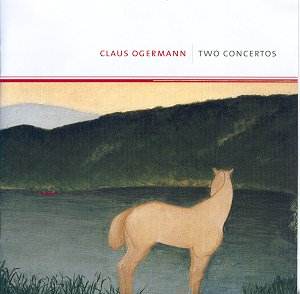
Claus OGERMANN (b.1930)
Piano Concerto (1993) [19.03]
Concerto For Orchestra (1991) [44.59]
Clauss Ogermann (piano)
National Philharmonic Orchestra/Claus Ogermann
Rec – details not given
DECCA 013949-2 [64.03]
The trouble with Claus Ogermann has always been the trouble with crossing over—nobody quite knows where to put you, and the classical establishment tends to look the other way.
Here’s a composer who spent decades arranging for Sinatra and Jobim, who made his fortune in the studios, who understands orchestral color the way a perfumer understands scent. And yet these two works, recorded in the early 1990s, reveal something more substantial than the lush film-score gestures one might expect. The Piano Concerto opens with a wash of strings that could be Ravel filtered through Hollywood—but then Ogermann introduces harmonic progressions that owe more to Bill Evans than to any conservatory model. This isn’t pastiche. It’s autobiography.
The piano writing is idiomatic, sometimes ravishingly so. Ogermann plays his own solo part with the kind of relaxed authority that comes from knowing exactly what you meant—no virtuoso fireworks, but considerable poetry in the slow-moving middle section where the piano traces long melodic arcs over sustained orchestral chords. The influence of jazz harmony is pervasive without being obtrusive; Ogermann adds ninths and elevenths to his sonorities the way some composers add salt. The National Philharmonic responds with burnished tone, though one wishes for more transparency in the densely scored climaxes. The disc itself—Decca provides no details, frustratingly—has that slightly airless quality of studio sessions from this period.
But it’s the Concerto For Orchestra that makes the stronger case. Nearly forty-five minutes long, structured in five movements that flow without pause, it’s an ambitious work that sustains interest through sheer coloristic invention. The opening movement builds from whispered tremolando strings to full orchestral statements with genuine dramatic shape. Ogermann knows how to pace a long span—he had to, working in popular music—and he brings that skill to bear here.
The second movement functions as a scherzo, though “scherzo” hardly captures the jazz-inflected rhythmic play, the sudden shifts between 4/4 and 5/4 that never sound academic. There’s a flute solo in the third movement, emerging from harp arpeggios, that recalls the Gil Evans arrangements for Miles Davis—that same careful spacing of instrumental voices, that refusal to fill every sonic space. Whether this belongs in a concert hall or not seems beside the point. It’s exquisite.
The finale does run long. Ogermann circles back to earlier thematic material, sometimes too insistently, and one feels the piece straining against its own ambitions. A tighter structure—maybe thirty-five minutes instead of forty-five—might have served him better. But there’s genuine invention here, genuine craft. The orchestration alone repays study: notice how Ogermann uses muted brass, how he pairs instruments in unexpected combinations, how he creates depth through careful layering rather than mere volume.
Is this important music? Probably not. Is it accomplished, sincere, often quite lovely? Absolutely. Ogermann writes from a different tradition than the academic serialists who dominated new music in the early 1990s, and his work suffers from that accident of timing. These pieces deserve better than to languish in the crossover ghetto—they’re too sophisticated for easy listening, too tonal for the contemporary music crowd. Which leaves them in a peculiar limbo.
The performances sound committed, though conducting oneself in one’s own works is always a risky business. Ogermann doesn’t indulge, doesn’t linger—he keeps things moving. The Decca sound, for all its lack of documentation, captures the orchestral blend effectively. You can hear into the texture when it matters.
This disc won’t change anyone’s life. But it offers genuine pleasure, and it documents a composer whose facility with orchestral color deserves recognition, even if he earned it in the wrong zip code. Worth hearing, if you can find it.