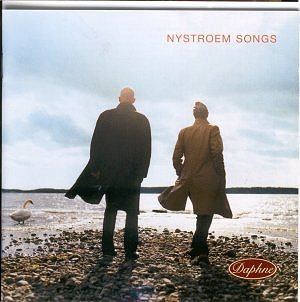
NYSTROEM Songs
Gösta Nystroem (1890-1966)
Charlotte Hellekant (mezzo-sop), Ander Kilström (piano)
DAPHNE 1017 (70.54)
The Sea’s Melancholy: Nystroem’s Songs in Exemplary Hands
There’s something almost perverse about Gösta Nystroem’s relationship with modernism. Here was a composer who spent formative years in Paris during the 1920s—that crucible of artistic revolution—yet his songs, collected on this valuable Daphne disc, remain stubbornly, even defiantly late-Romantic. The oil painting reproduced in the booklet, “Nina, Copenhagen, 1917,” hints at cubist geometries and Modigliani-esque elongations. But the music? Debussy, certainly. Sibelius, unmistakably. Perhaps a whisper of Grieg’s harmonic world. But Stravinsky? Schoenberg? The jazz that was electrifying Paris nightclubs? Not a trace.
This isn’t a criticism—or not exactly. Nystroem knew what he was about. Born inland in Dalarna but spiritually wedded to the sea, he preferred the austere company of Swedish fishermen to Parisian café society, and his songs reflect that ascetic choice. The twenty-five songs here span nearly four decades, from the 1914 “Andakt” to the 1950 Själ och landskap (Soul and Landscape), and what’s remarkable is how consistent his aesthetic remains. These are songs of contemplation, of loss, of the sea’s vast indifference—predominantly slow, predominantly melancholic, predominantly luminous.
Charlotte Hellekant possesses exactly the voice this repertoire demands. Her lower register has real substance—never forced, never hollow—while the upper range floats with that particular Nordic luminosity that suggests winter light on water. The five songs of Sånger vid havet (Songs by the Sea) from 1943 establish the disc’s emotional terrain: Ebba Lindkvist’s texts find in Nystroem a composer who understood that the sea is never merely picturesque. “Ute i skären” opens with recitative-like vocal lines that intensify into genuine melody, and Hellekant navigates these shifts with complete naturalness. Andreas Kilström—whose contribution is genuinely equal to the singer’s—provides not mere accompaniment but atmospheric environment, those piano textures suggesting fog, distance, solitude.
The eight songs of Ur Ångest (From Agony, 1923–28) to Pär Lagerkvist’s dark poetry represent Nystroem at his most expressionistic. Here, finally, we hear something of the modernist impulse—these are mood-pictures that occasionally recall Schoenberg’s Book of the Hanging Gardens, though Nystroem never abandons tonality entirely. Hellekant brings real dramatic force to these songs, and her diction—always exemplary throughout the disc—makes the percussive qualities of Swedish particularly vivid. One doesn’t need to understand the language to sense the despair in Lagerkvist’s words.
But then—a jolt. “Att älska i vårens tid” (To Love in Springtime) from 1949 arrives like a boulevardier crashing a funeral. This is Nystroem in popular mode, all Viennese coffee-house charm, with echoes of Lehár floating through the piano part. It’s disorienting after the preceding gloom, though not unwelcome. The two folk-song settings—“Gubben och gumman skulle mota vall” and particularly “Det satt en katt vid Kattegatt“—offer similar relief, the latter song wonderfully witty in both text and setting. Hellekant clearly relishes these lighter moments; her vocal coloring becomes more playful, more varied.
The second Sånger vid havet set from 1950 (titled Själ och landskap but thematically linked to the earlier cycle) returns to that characteristic Nystroem territory: lonely, lyrical, elegiac. The final song on the disc, the 1924 “Nocturne” to Anders Österling’s text, finds Hellekant at her most refined—the voice floats above Kilström’s nuanced harmonic mists with exquisite control.
The recorded sound is admirably natural—voices and piano occupying the same acoustic space without artificial spotlighting. Daphne has provided complete texts in Swedish, English, and German (though one wishes they’d included track numbers alongside each song text for easier reference). The liner notes by Christina Tobeck are informative without being academic.
What strikes me most forcefully about this collection is Nystroem’s essential integrity. He wasn’t interested in being fashionable or shocking. He found his voice—melancholic, sea-haunted, harmonically rich but never ostentatious—and he remained faithful to it across decades. Some might call this conservative. I’d call it honest.
Hellekant and Kilström serve this music with complete dedication and considerable artistry. For those who love Scandinavian song—and really, for anyone who responds to Finzi’s introspective lyricism or Britten’s ability to set English with perfect naturalness—this disc offers substantial rewards. It’s not groundbreaking music. But it’s deeply felt, beautifully crafted, and in these performances, utterly persuasive.