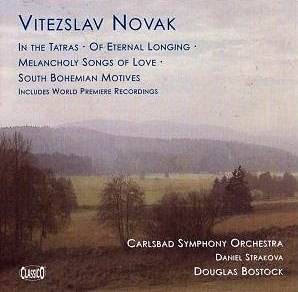
NOVAK In the Tatras; About the Eternal Longing; Melancholy Songs of Love; South Bohemian Motifs
Vitezslav Novak (1870-1949)
Daniela Strakova (sop), Carlsbad SO/Douglas Bostock
CLASSICO CLASSCD 256 (73.13)
Vitezslav Novák remains one of those figures who haunt the margins of the repertoire—not quite forgotten, but never quite remembered either. This Classico disc, recorded in the spa town of Carlsbad (one imagines the waters still flowing as the orchestra set up), offers a generous sampling of his orchestral work, and the question it poses is simple enough: does the neglect matter?
The answer is complicated. Novák studied with Dvořák, absorbed the lessons of both Brahms and early Strauss, and emerged with a voice that’s unmistakably his own—which is to say, unmistakably Czech, but Czech filtered through a late-Romantic sensibility that sometimes threatens to overwhelm the folk materials it’s built upon. In the Tatras, the earliest work here, shows him at his most confident. The piece surges and recedes like the mountain landscapes it evokes, though Novák’s orchestration—thick, chromatic, restless—never quite achieves the transparency of his teacher. Douglas Bostock conducts with real conviction, pushing the Carlsbad Symphony through the dense textures with a clarity that serves the music well. The brass don’t always respond with perfect unanimity, but there’s an earnestness to the reading that’s touching.
About the Eternal Longing is where things get thornier. The title alone should warn you: this is music that wears its heart not on its sleeve but tattooed across its chest. Forty-some minutes of yearning, striving, reaching toward… what, exactly? Novák never quite tells us. The thematic material is strong—that opening horn call has a genuine nobility—but the development sprawls. One hears Wagner, one hears Strauss, one hears Scriabin’s ecstatic harmonies without quite the same focus or purpose. The piece needs an advocate, and Bostock does his best, but even he can’t entirely justify the repetitions or the climaxes that arrive right on schedule.
The Melancholy Songs of Love bring Daniela Straková into the picture, and her presence shifts the balance considerably. Her voice—a lyric soprano with a slight edge that reads as character rather than flaw—handles Novák’s vocal writing with real understanding. These are art songs orchestrated, essentially, and they benefit from the intimacy she brings. “The First Snowdrop” (if I’m reading the Czech titles correctly) has a delicacy that the purely orchestral works sometimes lack. She colors the words without distorting them, finds the line without forcing it.
South Bohemian Motifs, written when Novák was in his seventies and the world had changed utterly around him, surprises. Here the textures thin out, the harmonies simplify—not from exhaustion but from wisdom, perhaps. The folk elements emerge more clearly, less encrusted with chromatic barnacles. It’s touching music, autumnal without being defeated. The Carlsbad players sound most at home here, in music that doesn’t ask them to compete with Vienna or Berlin but to sing in their own accent.
The recorded sound is serviceable rather than distinguished—a bit congested in the loudest passages, the strings lacking the last degree of bloom. But you can hear what you need to hear.
So: does Novák’s neglect matter? On this evidence, yes and no. He’s a real composer with real things to say, but he’s also a composer whose reach sometimes exceeded his grasp, whose rhetoric could outrun his invention. The best of this music—parts of In the Tatras, all of South Bohemian Motifs, several of the songs—deserves to be heard. The rest? It’s honorable work by a serious artist, which isn’t nothing. Bostock and his forces make the strongest possible case, and that counts for something too.