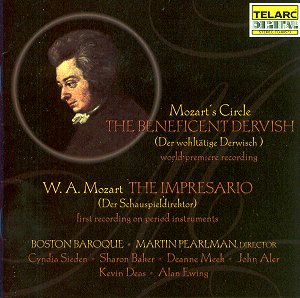
MOZART The Impresario / The Beneficent Dervish
Wolfgang Amadeus Mozart (1756-1791)
Cyndia Sieden, soprano; Sharon Baker, soprano; John Aler, tenor; Kevin Deas, bass-baritone; Deanne Meek, mezzo-soprano; Boston Baroque, Martin Pearlman
TELARC CD-80573 (66:16)
Two Mozart Singspiele, One a Trifle, One Not Quite
Martin Pearlman and Boston Baroque have done us the service—or perhaps the disservice—of coupling Mozart’s Der Schauspieldirektor with Der Wohltätige Derwisch, a work from Mozart’s circle that makes one grateful Mozart didn’t actually compose it himself. The pairing is instructive, though not always in ways Telarc might have intended.
Der Schauspieldirektor we know, or think we do. Written in haste for a court entertainment at Schönbrunn in 1786, it’s barely an opera—more a concert piece with pretensions, four musical numbers linked by spoken dialogue that on this disc exists only in our imagination. What remains is Mozart at his most wickedly observant: the overture bustles with theatrical energy, and the two soprano arias let us eavesdrop on the vanity of prima donnas auditioning for an impresario who knows exactly what he’s getting into.
Cyndia Sieden brings gleaming tone and impressive coloratura to “Bester Jüngling,” though her vibrato widens under pressure in the upper register—a minor quibble in singing that’s otherwise secure and stylish. Sharon Baker matches her in “Da schlägt die Abschiedsstunde,” with a warmer, more rounded sound that suggests genuine feeling beneath the character’s theatrical posturing. The subsequent trio and quartet let these sopranos spar deliciously, with John Aler’s elegant tenor and Kevin Deas’s robust bass-baritone providing ballast. Aler’s voice, recorded here when it still had bloom and freedom in the passaggio, reminds us what we lost when he started pushing too hard later in his career.
Pearlman conducts with his characteristic intelligence and period awareness. The orchestra, playing at what sounds like A=430 or thereabouts, produces lean, transparent textures that never turn astringent—no small achievement with Telarc’s sometimes overly analytical engineering. Tempos feel right, neither dawdling nor rushed, and the articulation has that crisp elegance we associate with Mozart performance in the post-Norrington era without the aggressive edge that sometimes accompanied it.
But then comes Der Wohltätige Derwisch.
This Turkish-themed singspiel from 1791 was long thought lost, and one understands why no one mounted a vigorous search. The liner notes diplomatically suggest it may have been composed by Franz Xaver Gerl, the first Sarastro, or perhaps Johann Baptist Henneberg. Whoever perpetrated it lacked Mozart’s melodic gift, his harmonic imagination, his sense of dramatic pacing. The arias plod where they should soar; the ensemble writing sounds dutiful rather than inspired. Poor Sharon Baker and Deanne Meek labor mightily in music that gives them little to work with—Baker especially deserves credit for making something nearly shapely out of her second-act aria, though the material defeats even her musicianship.
The Turkish elements—those jangling triangles and booming bass drums—arrive with all the subtlety of a tourist brochure. Where Mozart in Die Entführung had used such colors with wit and sophistication, this composer simply throws in the percussion whenever he remembers the opera is supposed to be exotic. Pearlman and his players do what they can, but you can’t make silk purses, etc.
The real value here lies in hearing what Mozart’s contemporaries were producing, and by that standard Der Wohltätige Derwisch succeeds brilliantly as a teaching tool. It shows us, with uncomfortable clarity, the distance between competent craftsmanship and genius. Every pedestrian modulation, every predictable cadence, every melody that sags when it should lift—these failures illuminate Mozart’s achievements in ways that scholarly analysis cannot quite capture.
The recorded sound captures Boston’s First and Second Church acoustic with typical Telarc spaciousness, perhaps too much of it. The voices sit naturally within the instrumental frame, though the engineering occasionally spotlights details—a particularly aggressive oboe entrance, the thwack of timpani sticks—that a warmer acoustic might have integrated more smoothly.
This recording will interest Mozart completists and scholars more than the general listener. Der Schauspieldirektor receives an outstanding interpretation that stands comparison with the best alternatives, but you can get it elsewhere without the dubious bonus of Der Wohltätige Derwisch. Unless you’re writing a dissertation on Mozart’s theatrical milieu, you might do better with one of those other versions. The singing here is too good to ignore entirely, but sixty-six minutes proves a long time to spend with one masterpiece and one… well, one that isn’t.