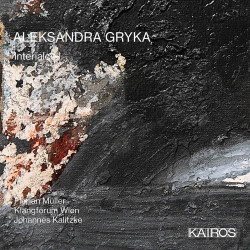
Aleksandra GRYKA (b. 1977) Interialcell
Aleksandra Gryka (b. 1977)
Florian Müller (harpsichord), Andreas Harrer (technician), Klangforum Wien/Johannes Kalitzke
KAIROS 0015110KAI (46:50)
The Poles have been giving us interesting composers lately—Penderecki, Górecki, Lutosławski in earlier generations, and now Aleksandra Gryka, born in 1977, whose music arrives on this Bridge release (though the booklet says Kairos, one of several labeling confusions) with the kind of confidence that can read as brashness. Or maybe just clarity of purpose.
Gryka works in that post-spectral zone where timbre becomes structure and structure dissolves into—well, into something that resists easy categorization. These five pieces, spanning seventeen years of her output, share a preoccupation with cellular processes, with material that mutates and replicates rather than develops in any classical sense. The titles themselves signal this: Interialcell, Emtyloop, Mutedisorder. Neologisms that feel vaguely biological, vaguely digital. Both, probably.
Youmec for harpsichord and tape opens the disc, and it’s a strange, compelling thing. Florian Müller attacks the harpsichord with a percussive intensity that has nothing to do with baroque graces—this is the instrument as resonating box, as collection of plucked attacks and metallic afterimages. The tape part (Andreas Harrer is credited as “technician,” whatever that means in 2021) doesn’t so much accompany as infiltrate, processing and warping the harpsichord’s already fragile sustain into something ghostly. At just under six minutes, it doesn’t overstay its welcome. Smart.
The ensemble version of Interialcell from 2003 shows Gryka’s materials in a different light—or rather, in multiple lights simultaneously. Klangforum Wien, those indispensable specialists, navigate the score’s demands with their characteristic precision. What demands? Well, there’s a lot of microtonal inflection, a lot of timbral matching between winds and strings that requires players to really listen across sections. Johannes Kalitzke keeps things moving without imposing false drama. The piece builds through accretion, small gestures piling up until they achieve a kind of critical mass, then dissipating. It’s effective, though whether it needs nearly seven minutes to make its point is debatable.
Emtyloop—which the booklet variously describes as for ensemble and string quartet, and which is indeed a string quartet, not an ensemble piece, another labeling error in a disc full of them—occupies the disc’s center both physically and aesthetically. Twelve minutes is a real span, and Gryka fills it with material that justifies the duration. The quartet format forces her to work with a more limited palette, and the constraint proves productive. There’s a passage about four minutes in where the viola and cello lock into a rough unison while the violins trace overlapping ellipses above—it’s the kind of thing that looks simple on paper but requires absolute security of intonation and rhythm to pull off. Klangforum’s quartet players have it.
The two later ensemble pieces, einerjedeneither and Mutedisorder, find Gryka refining her language without fundamentally changing it. The former, from 2011, plays with the spatial possibilities of the ensemble—instruments emerging from and receding into the texture in ways that suggest careful positioning in the hall. The latter, from 2015, is perhaps the most immediately appealing piece here, with actual melodic fragments (heavily disguised, but there) surfacing through the timbral haze. Both pieces benefit from Klangforum’s ability to make difficult music sound not easy, exactly, but natural. Inevitable.
The album, made in the Wiener Konzerthaus across January and February 2021, captures the ensemble in clear, detailed sound. Maybe a bit too clear—there’s a certain clinical quality that doesn’t always serve music that, for all its systematic rigor, has genuine expressive ambitions. But you can hear everything, which with music this densely layered matters.
Does Gryka’s music add up to more than the sum of its procedures? Sometimes. The best moments on this disc—that viola-cello unison in Emtyloop, the ghostly harpsichord resonances in Youmec, the surprising melodic turn in Mutedisorder—suggest a composer who understands that system and expression needn’t be enemies. The weaker moments feel like demonstrations of artistry rather than communications of… something harder to name. But she’s still working, still developing. This is valuable documentation of a composer worth following, even if—especially if—you’re not yet entirely convinced.