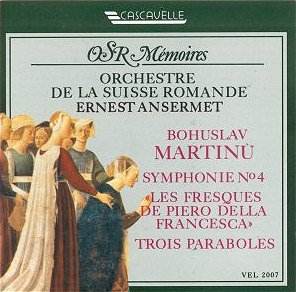
MARTINŮ Frescoes of Piero della Francesca; Parables; Symphony No. 4 (Ansermet)
Bohuslav Martinů (1890-1959)
Orchestre de la Suisse Romande/Ernest Ansermet
CASCAVELLE VEL 2007 (73:39)
Ansermet’s Martinů: Live Fire from the Archives
The Swiss label Cascavelle has been quietly doing essential work—rescuing broadcast performances from Radio Suisse Romande’s vaults, preserving not just sound but interpretive traditions that might otherwise vanish. This Martinů disc, drawn from concerts between 1961 and 1967, offers something rarer than archival curiosity: it captures Ernest Ansermet in a state of creative heat that his studio recordings only occasionally suggest.
I confess I’ve long been ambivalent about Ansermet. Those Decca sessions—immaculate, controlled, sometimes maddeningly cautious—can make one forget that this was a maestro who championed The Rite of Spring when the ink was barely dry. But here, with a live audience and Martinů’s restless, asymmetric energy coursing through the scores, we get something closer to the man who must have electrified Geneva in the 1920s.
The Frescoes of Piero della Francesca erupt from the speakers with a violence I haven’t encountered elsewhere. Ansermet treats this 1955 score not as decorative Renaissance nostalgia but as molten material—Stravinskian blocks of sound colliding, lyrical lines that don’t so much sing as fly apart in mid-phrase. The opening movement, “Les suivantes de la reine de Saba,” has a glittering hardness; you can hear the orchestra leaning into those asymmetric rhythms, brass cutting through the texture with almost uncomfortable clarity. When we reach “Les batailles,” the percussion section sounds genuinely dangerous.
The mono sound is unsophisticated, yes—there’s a certain glare in the upper strings, a congestion when the full ensemble opens up. But I’ll take this sonic compromise for the interpretive rewards. Studio perfection can be the enemy of urgency.
Symphony No. 4 receives what may be the finest reading here. Written in 1945 while Martinů was still processing his wartime exile, this is the most generous-spirited of his six symphonies—not naive, but determinedly life-affirming. Ansermet understands this duality. The opening Poco moderato has tremendous forward momentum without sacrificing that characteristic Martinů shimmer, those overlapping melodic cells that create harmonic halos. The second movement “Allegro ”vivo does slacken slightly—I notice the rhythmic grip isn’t quite as iron-clad as in Martin Turnovsky’s sadly deleted Supraphon disc—but the compensating lyrical warmth is considerable.
It’s in the Largo that Ansermet truly distinguishes himself. Where other conductors find pastoral consolation, he discovers something darker, more elegiac. The wide-striding melody in the strings has real tragic weight here, and when those muted brass chords enter, they sound like distant bells tolling for something irretrievable. This is war music, after all, even if Martinů clothes it in major-key optimism. The finale’s Poco allegro generates furious excitement, though again Turnovsky’s tighter rhythmic control gave those syncopations more bite.
The Parables—three movements inspired by texts from George Neveu and Saint-Exupéry—present Martinů at his most elusive. Written between 1957 and 1958, these are late works, and they have that quality of transparency that sometimes comes when a composer has burned through stylistic anxieties. “The Parable of a sculptor” opens with string writing that immediately suggests Sibelius—those long, sustained lines that seem to emerge from silence rather than being constructed. But then a rustic woodwind voice intrudes, all reedy and rough-edged, like something from a Provençal village square.
“The Parable of the garden” is the most overtly lyrical movement, though Martinů’s lyricism is never quite comfortable—melodies overlap and interrupt each other, creating a kind of polyphonic restlessness. Ansermet brings out the Vaughan Williams connection here; there’s a similar quality of English pastoral filtered through modernist techniques, though Martinů’s Czech roots give the music a different harmonic flavor.
The final “Parable of the labyrinth” turns phantasmal. Those wraith-like string textures anticipate The Epic of Gilgamesh, Martinů’s last major work. Ansermet doesn’t try to clarify the music’s mysteries—he lets it remain enigmatic, even a bit unsettling. The ending simply evaporates, like morning mist.
The documentation is adequate—Ansermet’s own notes in three languages—though I wish someone had provided more context about these particular performances. Were they part of a Martinů festival? What was the critical reception? These questions linger unanswered.
I keep returning to the fundamental question this disc raises: why does Ansermet sound so much more vital here than in his studio work? Part of it must be the presence of an audience, that indefinable current of communication that flows both ways. Part of it may be Martinů himself—music that resists polish, that needs a certain roughness to fully live. Whatever the reason, these performances have an authenticity that transcends their sonic limitations.
For Martinů enthusiasts, this disc is essential. For those curious about Ansermet beyond the Decca legacy, it’s revelatory. The Fourth Symphony alone justifies the price of admission, and the Frescoes offer a glimpse of this music’s raw power that more refined recordings sometimes obscure. Seek it out.