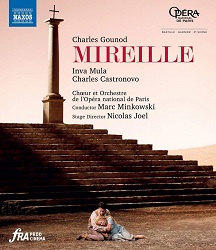
GOUNOD Mireille – Opera in five acts and seven tableaux (1864)
Charles Gounod (1818-1893)
Inva Mula (soprano); Charles Castronovo (tenor); Sylvie Brunet (mezzo-soprano); Franck Ferrari (baritone); Alain Vernhes (baritone); Anne-Catherine Gillet (soprano); Sébastien Droy (tenor); Nicolas Cavalier (bass); Amel-Brahim Djelloul (soprano); Ugo Rabec (bass); Choeur et l’Orchestre de l’Opéra national de Paris/Marc Minkowski
NAXOS NBD0126V (151 mins)
Provençal Sunlight at the Palais Garnier
Gounod’s Mireille has never quite managed to secure a foothold in the international repertory, despite the composer’s evident affection for this score—he revised it obsessively, never quite satisfied, always tinkering. One understands why. The opera, based on Frédéric Mistral’s epic poem in Provençal, offers a pastoral idyll that can seem perilously close to the precious, a love story between a wealthy farmer’s daughter and a poor basket-weaver that unfolds with almost anthropological detail about rural Provence. It’s Cavalleria Rusticana without the verismo bite, Roméo et Juliette transplanted to the fields and painted in softer pastels.
This 2009 production from the Opéra national de Paris, now released on Blu-ray by Naxos, makes the strongest possible case for the work. Marc Minkowski conducts with an ear for the score’s particular beauties—the orchestral writing glows with Mediterranean warmth, the winds especially catching that quality of light you find in the south of France, golden and somehow more transparent than elsewhere. He doesn’t push for drama that isn’t there. Instead, he luxuriates in Gounod’s melodic invention, which is considerable, and in the composer’s subtle orchestral palette.
The famous “Waltz Song,” “Ô légère hirondelle,” arrives in Act I like a gift—Inva Mula floats it with that particular kind of French soprano ping that sits just at the edge of the voice without ever toppling into shrillness. She’s an intelligent singer, Mula, and she understands that Mireille’s journey from innocent girl to tragic victim requires more than just pretty tone. Her Act V delirium scene, as Mireille crosses the burning Crau plain to reach the shrine of the Saintes-Maries, shows real dramatic commitment. The voice thins a bit under pressure in the upper register—one hears the effort—but the theatrical conviction carries the moment.
Charles Castronovo brings his usual honeyed tenor to Vincent, though I wish he’d found more variety of color in the role. The voice is beautiful, no question, with that easy top that makes Gounod’s soaring phrases sound effortless. But Vincent remains a bit of a cipher, noble and earnest and… well, a touch bland. Castronovo sings “Anges du paradis” with touching simplicity, yet one wants more psychological shading, more sense of the character’s inner life.
The supporting cast proves uniformly strong. Franck Ferrari’s Ourrias—the brutish muleteer who desires Mireille—has the necessary dark-toned menace, though Nicolas Joel’s production doesn’t quite know what to do with him dramatically. Alain Vernhes as Mireille’s father Ramon brings genuine authority; his confrontation with Vincent in Act III has proper patriarchal weight. Anne-Catherine Gillet’s Vincenette sparkles in her brief appearances, and Sylvie Brunet’s Taven—the witch-like figure who prophesies disaster—finds the character’s eerie quality without resorting to caricature.
Joel’s staging, designed by the late Ezio Frigerio with costumes by Franca Squarciarpino, opts for a kind of heightened naturalism. The sets suggest Provence without slavishly reproducing it—stylized wheat fields, a simplified mas, the rocky landscape of the Crau rendered in earth tones and careful lighting. It’s handsome without being particularly imaginative. The production dates from 2009, and already one can see it settling into a certain conventional approach to 19th-century opera that neither offends nor particularly excites.
Vinicio Cheli’s lighting design deserves mention—he captures something essential about the quality of Provençal light, that fierce brightness that can seem almost hallucinatory. The final scene, set at the shrine with Mireille’s vision of angels, could easily tip into kitsch, but Cheli’s lighting gives it a genuine sense of transcendence.
The Palais Garnier chorus, prepared by Patrick Marie Aubert, sings with the polish one expects from this company. The farandole in Act IV has proper festive energy, and the final chorus achieves genuine solemnity. Minkowski keeps everything moving at a good clip—this is not a long opera, even in Gounod’s expanded five-act version, and the maestro doesn’t dawdle.
The video direction captures the production clearly, though I found myself wishing for more close-ups during the intimate moments. The sound in PCM stereo (I didn’t sample the surround option) places the orchestra a bit forward for my taste, but the balance allows one to hear Gounod’s lovely woodwind writing and the subtle harp touches that punctuate the score.
One small quibble: the inclusion of Japanese and Korean subtitles suggests Naxos is targeting Asian markets where French opera still finds enthusiastic audiences—a reminder that repertory tastes differ significantly across the globe. The English subtitles are serviceable if occasionally awkward.
Does this release make a case for Mireille as an unjustly neglected masterpiece? Not quite. The opera remains what it is: a exquisite, somewhat fragile work that requires nearly ideal conditions to succeed. But Minkowski and his forces come close to providing those conditions, and Mula’s committed rendition gives the piece its necessary center. For those curious about Gounod beyond Faust and Roméo, this offers a rewarding glimpse of the composer in pastoral mode, writing music of genuine charm and occasional surprising depth.
The disc includes a brief documentary about the production—standard EPK material—and a short featurette on Mistral’s poem. Nothing essential, but pleasant enough.
A final thought: one does hope Naxos will get around to releasing that Ravel double bill from Glyndebourne that’s been languishing in the vaults. In the meantime, this Mireille fills a gap in the video catalog and does so with considerable musical distinction, even if it doesn’t quite transform our sense of the work’s ultimate value.