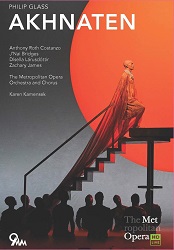
GLASS Akhnaten, opera in three acts (1984)
Philip Glass (b. 1937)
Anthony Roth Costanzo (counter tenor), Zachary James (actor), Richard Bernstein (bass), Dísella Lárusdóttir (soprano), J’Nai Bridges (mezzo), Aaron Blake (tenor), Will Liverman (baritone), Skills Ensemble, Metropolitan Opera Orchestra and Chorus/Karen Kamansek
ORANGE MOUNTAIN DVD OMM5011 (172:00)
The Metropolitan Opera’s production of Akhnaten arrives on video at an interesting moment—Glass’s opera, which seemed so marginal when it premiered in Stuttgart in 1984, has become something like a repertory piece. Who would have predicted that?
Phelim McDermott’s staging, already familiar from its London incarnation, remains a curious hybrid of visual splendor and theatrical restraint. The Skills Ensemble jugglers—yes, jugglers—weave through the action with hypnotic precision, their balls and clubs tracing arcs that somehow embody the opera’s circular structures without descending into gimmickry. Tom Pye’s sets evoke both archaeological diagram and fever dream, with projections that breathe without overwhelming. When Akhnaten’s sun disk rises, you feel the pull of religious mania. Bruno Poet understands how light can become architecture in Glass’s static tableaux.
Anthony Roth Costanzo owns this role now. His countertenor has that peculiar quality Glass’s vocal writing demands—not prettiness exactly, but a kind of androgynous radiance that exists outside conventional operatic beauty. In “Hymn to the Sun” he spins those long, arching phrases with breath control that borders on the supernatural, and the Hebrew text emerges with unusual clarity. The voice itself has hardened slightly since his earlier performances, gained an edge that serves the character’s increasing isolation. This Akhnaten isn’t ethereal; he’s obsessed, dangerous even.
J’Nai Bridges brings warmth to Nefertiti’s often thankless music—Glass gives her less to do than you’d hope, but Bridges finds emotional contours in those repetitive patterns. Her duet with Costanzo in Act Two generates genuine heat, the voices circling each other like planets in elliptical orbit. Dísella Lárusdóttir’s Queen Tye commands attention in her brief appearances, the soprano cutting through Glass’s orchestral density with laser focus.
The supporting cast acquits itself well. Richard Bernstein’s bass grounds the proceedings with proper gravitas, though Zachary James as the scribe feels underused—the device of having contemporary scholars narrate (in English, naturally) still strikes me as more clever than dramatically effective. Will Liverman’s Horemhab suggests genuine menace in his Act Three intervention, not just political expedience.
Karen Kamensek conducts with admirable discipline. She grasps that Glass’s motor rhythms need propulsion without aggression, that the harmonic shifts—when they finally arrive—must land with tectonic force. The Metropolitan Opera Orchestra plays with precision that would have seemed impossible in 1984, when American orchestras treated minimalism with barely concealed contempt. Listen to the arpeggiated figures in the prelude: they’re genuinely exquisite, not merely functional. The brass chorale that accompanies Akhnaten’s coronation blazes without brutality.
But here’s the thing about Akhnaten that this production can’t quite overcome—the opera’s dramatic architecture remains fundamentally inert. Glass and librettists Shalom Goldman, Robert Israel, Richard Riddell, and Jerome Robbins assembled their historical fragments with scholarly care, but the opera never quite catches fire as theater. Things happen. Akhnaten rises, loves, falls. We observe rather than engage. McDermott’s jugglers and visual poetry can’t solve what may be an insoluble problem: Glass’s aesthetic resists conventional dramatic momentum.
The video direction captures the production intelligently, though I wish for more close-ups during the Act Two love scene—you want to see Costanzo and Bridges’ faces as they navigate those intertwining lines. The audio quality is exemplary, with proper balance between pit and stage. Subtitles help, though hearing the ancient languages emerge from Glass’s vocal writing remains part of the opera’s strange power.
Orange Mountain’s disc includes minimal extras—some interviews, production stills. The booklet provides useful context without academic bloat.
So: essential viewing for Glass devotees, certainly. Costanzo alone justifies the purchase, and McDermott’s production photographs gorgeously. But if you’ve never warmed to Glass’s brand of minimalism, this won’t convert you. The opera’s beauties are real but narrow, its emotional range deliberately constrained. After 135 minutes, I admired much, was moved occasionally, and felt oddly distant from it all—which may be precisely what Glass intended.