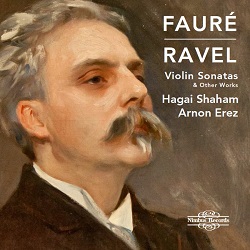
Gabriel FAURÉ (1845-1924)
Berceuse, Op 16 (1880) [3:36]
Violin Sonata No 1, Op 13 (1876) [25:12]
Violin Sonata No 2, Op 108 (1917) [23:27]
Maurice RAVEL (1875-1937)
Berceuse sur le nom de Fauré, M.74 (1922) [2:39]
Violin Sonata Movement in A minor, M.12 (1897) [2:39]
Hagai Shaham (violin)
Arnon Erez (piano)
rec 25-27 April 2014, Wyastone Concert Hall, Monmouth, UK
NIMBUS RECORDS NI8107 [68:30]
A French Inheritance: Shaham and Erez in Fauré and Ravel
There’s something to be said for thematic coherence. This Nimbus release pairs Hagai Shaham and Arnon Erez in what amounts to a sustained meditation on French violin writing across four crucial decades—though the programming, while intelligent, occasionally feels more dutiful than inspired.
The disc opens with Fauré’s Berceuse, Op. 16, that deceptive little gem from 1880. Deceptive because what sounds like salon music harbors surprising harmonic ambiguities beneath its lulling surface. Shaham plays it with admirable restraint—perhaps too much restraint. The tone is lovely, silvered and pure, but I found myself wanting more shadow, more of that peculiarly Fauréan melancholy that Ginette Neveu used to find in even the composer’s most seemingly innocent pages. The vibrato is sparing to the point of austerity. One understands the aesthetic choice—this is period-informed playing without being explicitly historicist—but the music can bear more expressive weight than it’s given here.
The First Violin Sonata, Op. 13, fares better. This is early Fauré, before the harmonic language had fully ripened into the extraordinary late works, but already there’s that characteristic elusiveness, the way phrases seem to dissolve just as you grasp them. The opening Allegro molto has always struck me as oddly Brahmsian—not in style but in ambition, in its determination to make chamber music think symphonically. Shaham and Erez understand this. Their first movement has genuine architecture, though the violin entry at the repeat does indeed sound tentative, almost exploratory, as if Shaham is testing the acoustic space. Whether this is interpretive choice or momentary uncertainty, I couldn’t say.
The Andante sings beautifully. Erez’s piano work throughout this disc deserves special mention—his touch in these gently rocking accompaniment figures is both precise and yielding, never merely metronomic. The finale rushes past in a blur of double-stops and cascading scales. Perhaps too much of a blur? The breathlessness is certainly intentional, but I missed some of the playfulness that can emerge when the tempo is fractionally more spacious.—Ravel’s Berceuse sur le nom de Fauré serves as the disc’s conceptual hinge, and it’s here that the performers find their most persuasive voice. This 1922 miniature—Ravel’s homage written for the elder composer’s 77th birthday—is a remarkable piece of musical cryptography. The melody spells out F-A-U-R-E using the solmization syllables (with D substituting for re), while the piano part ventures into harmonic territory that would have made the dedicatee raise an eyebrow. Shaham and Erez navigate this beautifully. The violin line floats with that Ravelian combination of simplicity and sophistication, while Erez manages to make the piano’s gnarled harmonies sound less like difficulties overcome than natural speech. The balance between the instruments is exemplary.
The early Violin Sonata Movement in A minor (and yes, it’s definitely A minor, not A major as the documentation claims) shows us the twenty-two-year-old Ravel still finding his way. The Debussy influence is unmistakable—those whole-tone inflections, the studied vagueness of outline. Here Shaham finally allows himself more vibrato, more tonal color, and the music benefits enormously. One hears a composer and performers both willing to take risks. The constantly shifting meters never feel labored; they simply breathe.—Fauré’s Second Violin Sonata, Op. 108, written in 1917 when the composer was seventy-two and increasingly deaf, is another matter entirely. This is music of extraordinary concentration and severity. The war years had stripped away whatever remained of nineteenth-century decorousness in Fauré’s language. The first movement is all sinew and nerve, the piano part fragmentary and restless beneath a violin line that can sound—should sound—almost raw.
Shaham and Erez give us a reading that emphasizes the work’s architecture perhaps at the expense of its anguish. The playing is scrupulously musical, carefully balanced, tonally refined. But this is music that was written against the backdrop of Verdun and the Somme, by a man watching his world disappear. I wanted more bite, more of what the French call âpreté—that quality of harshness, of astringency. The second movement, marked Andante, does capture something of the work’s strange inwardness, its refusal to offer easy consolation. The finale’s syncopations and cross-rhythms are executed with impressive precision, building to a conclusion that manages to be both triumphant and somehow provisional.
The Wyastone Concert Hall album is typically distinguished—warm but not overly reverberant, with the instruments captured in realistic perspective. Nimbus’s engineering allows us to hear both the individual timbres and the blended sonority without favoring one at the expense of the other.
This is accomplished, thoughtful playing that will satisfy listeners seeking refinement and clarity. What it lacks—and I recognize this may be deliberate—is a certain willingness to court ugliness, to let the music’s darker implications fully emerge. Fauré and Ravel both knew that beauty and pain are not opposites but intimates. Shaham and Erez give us mostly the former. It’s not enough, quite.