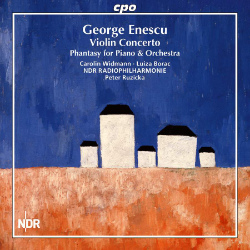
ENESCU Violin Concerto; Phantasy for Piano and Orchestra
George Enescu (1881-1955)
Carolin Widmann (violin), Luiza Borac (piano), NDR Radiophilharmonie/Peter Ruzicka
CPO 555 487-2 (53:33)
The teenage Enescu remains something of a puzzle.
We know the prodigy who astonished Vienna, the fifteen-year-old who wrote this Violin Concerto while still a student at the Paris Conservatoire. What we hear on this CPO release—and it’s a revelation, however qualified—is music that sounds simultaneously too old and too young for its composer, a work caught between the conservatory exercise and something more personal trying to break through.
The opening movement sprawls. There’s no getting around it. Enescu pours in everything he’s absorbed—Brahms, certainly, but also Vieuxtemps, Wieniawski, even hints of the French salon tradition he must have encountered in Paris. The thematic material itself is attractive enough, occasionally striking, but the seventeen-minute span tests the material’s genuine substance. One hears a young composer who hasn’t yet learned what to leave out, who mistakes profusion for richness. Carolin Widmann plays with admirable conviction, her tone lean and focused rather than lush—a wise choice that keeps the textures transparent even when Enescu’s orchestration threatens to become congested. She finds real poetry in the Andante sostenuto, where the composer’s later voice seems to peek through the conventional gestures. Those long-breathed phrases, the modal inflections that would become central to his mature style… they’re there, if you listen past the Brahmsian scaffolding.
Peter Ruzicka and the NDR Radiophilharmonie provide solid support, though I wish they’d found more light and air in the orchestral tuttis. The disc captures everything—perhaps too much. You hear every strand of the dense string writing, which doesn’t always work in the music’s favor.
The Phantasy for Piano and Orchestra from 1898 shows genuine progress. Shorter, tighter, more willing to actually take risks. Enescu was seventeen now, and something had shifted. The harmonic language ventures into more ambiguous territory—there are moments where you can hear him thinking toward the chromatic complexity of the mature works, the Oedipe still decades away but somehow implicit in these exploratory gestures. Luiza Borac brings formidable artistry and, crucially, doesn’t try to impose a false maturity on music that gains from its youthful ardor. Her passagework in the central section has real brilliance, though I found myself wishing for more variety in her dynamic palette. The loud passages are thrilling; the soft ones sometimes lack that inward quality this music occasionally reaches for.
The recorded sound—a 16-bit download from the press preview—is clean, detailed, perhaps a touch clinical for my taste. The Grober Sendesaal in Hannover provides a neutral acoustic that serves this repertoire adequately without adding much character. I found myself wanting more warmth in the string sound, more bloom around Widmann’s violin in the concerto’s lyrical episodes.
Both works remain juvenilia, let’s be clear about that. They’re fascinating juvenilia, certainly, essential for anyone tracking Enescu’s development from conservatory wunderkind to the composer of the Third Violin Sonata and Oedipe. But they’re not undiscovered masterpieces. The concerto sags under its own ambitions; the phantasy points toward a future it doesn’t quite reach.
Still, performances this committed make the strongest possible case. Widmann and Borac play as if they believe every note matters—which, for scholars and Enescu devotees, it does. For the general collector? This is specialized repertoire, handsomely presented but unlikely to displace your Bartók or Szymanowski. Worth hearing once, perhaps twice. Worth returning to? That depends on how deep your interest in Enescu runs, and whether you find these early works as suggestive of what was to come as I do—or merely suggestive.