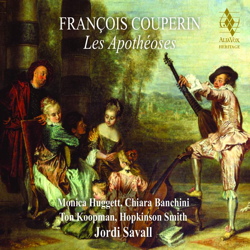
COUPERIN Les Apothéoses
François Couperin (1668-1733)
Monica Huggett (violin), Chiara Bachini (violin), Ton Koopman (harpsichord), Hopkinson Smith (theorbo), Bernard Hervé (reciter), Jordi Savall (bass viol and director)
ALIA VOX HERITAGE AVSA9944 SACD (47:02)
The French baroque—that world of exquisite manners concealing genuine passion, of rhetorical gestures that somehow never feel empty. Couperin’s two Apothéoses occupy a special place in this repertoire, not quite suites, not quite program music in any later sense, but rather elaborate tributes that allowed the composer to reconcile French and Italian styles while honoring his two great predecessors. This 1985 recording, now reissued by Alia Vox in splendid SACD format, catches Jordi Savall and his remarkable colleagues at a pivotal moment—early music performance was still finding its way, yet these artists already possessed that rare combination of scholarly rigor and improvisatory freedom.
L’Apothéose de Corelli opens the disc. Thirteen minutes that feel like entering Parnassus itself—if Parnassus smells faintly of rosin and old varnish. Monica Huggett’s violin has that slightly reedy, focused sound that the best baroque players cultivate, nothing lush or romanticized about it. When she and Chiara Bachini thread their way through “Corelli au pied du Parnasse prie les Muses de le recevoir parmi elles,” the double-stopped passages bloom with just enough friction to remind you these are gut strings responding to actual horsehair. Koopman’s harpsichord—recorded with unusual presence in the Lutheran church of Saint-Jean—provides more than continuo. It converses. His realizations have genuine wit, particularly in the “Remerciement de Corelli” where his right hand tosses off figures that Couperin might have approved but never wrote down.
The longer Apothéose de Lully presents thornier problems. Thirty-three minutes is a long time to sustain what is essentially a series of character pieces, however brilliant. Here’s where Savall’s direction proves invaluable—he understands pacing in ways that elude more literal-minded interpreters. The “Plainte des mêmes, pour des flûtes” (though no flutes appear here, the viols taking those parts) moves with genuine pathos, not the studied melancholy that can make French baroque music feel like an extended sigh. Bernard Hervé’s narration of the brief titles feels unnecessary in 1985 and still feels unnecessary now, but it’s brief enough.
What strikes me most about this rendition is the sheer variety of articulation. Listen to Hopkinson Smith’s theorbo—that instrument so often relegated to mere thudding punctuation. Here it sings, especially in the bass-heavy textures of “Lully jouant le Sujet, et l’accompagnant.” Smith finds melodic shapes in continuo parts that look like nothing on the page. His instrument was probably a Baroque original or a very fine copy; you can hear the slight unevenness of response between courses, the way certain notes bloom while others stay tight and focused. This is the sound of real materials, real craftsmanship.
Savall himself plays with his characteristic intensity—sometimes too much of it. In “La Paix du Parnasse” his bass viol threatens to overwhelm the texture, though the engineering (Radio France did itself proud here) keeps everything audible. The SACD transfer reveals details I certainly didn’t hear in earlier CD incarnations: the slight scrape of Huggett’s bow changes, the breathing of the players (yes, string players breathe with their phrases), even what sounds like the creak of Koopman’s bench during a particularly energetic passage in “Les Muses réveillent Lully.”
The surround sound places you in the church rather than in front of a proscenium—a mixed blessing. The spatial separation illuminates Couperin’s trio textures beautifully, but occasionally you’re too aware of individual instruments as physical presences rather than as blended voices. The acoustic of Saint-Jean proves ideal for this music, warm without being soupy, clear without clinical brightness.
This ensemble’s approach to French inégalité deserves mention. They don’t overdo it—the notes inégales have spring and lift without becoming mannered. When Huggett and Bachini play those paired eighths in “Lully est transporté au Parnasse,” the subtle lengthening of the first note of each pair provides just enough propulsion. It’s the kind of detail you absorb unconsciously, yet it makes all the difference between music that breathes and music that merely proceeds.
Some might find the whole enterprise a bit earnest. These are, after all, occasional pieces, elaborate jeux d’esprit that Couperin composed for private performances. The metaphor of Corelli and Lully meeting on Parnassus, reconciling French and Italian styles under Apollo‘s benign gaze—it’s charming, certainly, but does it support this much weight? In these hands, it does. The sincerity of the playing never tips into solemnity, and there’s genuine joy in the faster movements, particularly “La Paix du Parnasse faite à la prière de toutes les Muses françoises.”
Nearly forty years on, this disc holds up remarkably well—better, I’d argue, than many more recent attempts at this repertoire. The playing has conviction without rigidity, scholarship without pedantry. Yes, our understanding of French baroque performance practice has evolved, but not necessarily in ways that invalidate what Savall and company achieved here. If anything, we’ve circled back to some of their insights after a period of over-correcting.
The SACD remastering justifies the reissue. Alia Vox hasn’t simply upsampled old digital files; there’s genuine air and space around these instruments, a sense of the church acoustic that earlier releases only hinted at. Whether you need this in surround sound is another question—I’m not entirely convinced it adds enough to justify the format—but in stereo it sounds superb.
A distinguished achievement, then and now. These Apothéoses receive performances that honor both their playful conceit and their musical substance—no small feat when you’re trying to make 300-year-old cultural politics come alive. Savall and his colleagues succeed because they trust the music itself, not just the idea behind it. That trust proves well-placed.