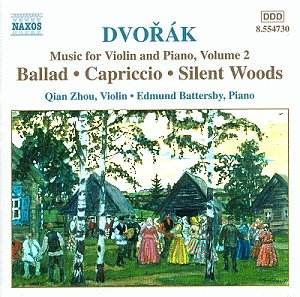
Dvořák: Ballade in D Minor; Capriccio; Humoresque, op. 101, no. 7; Slavonic Dances (arr. Kreisler); Silent Woods; Songs My Mother Taught Me; Nocturne in B Major
Qian Zhou, violin; Edmund Battersby, piano.
Naxos 8.554730. Recorded, Potton Hall. CD, 54:00.
There’s a particular pleasure—slightly guilty, entirely real—in a disc that makes no pretense to profundity. Dvořák wrote miniatures the way he breathed: naturally, without apparent effort, and with that Bohemian gift for melody that could make even a throwaway piece stick in the ear for days. This second volume of violin-and-piano music gathers the sort of program Kreisler used to close his recitals with—encores, really, dressed up and given the stage.
Kreisler’s shadow falls across much of this. His arrangements of three Slavonic Dances are the backbone of the disc, and they remain irresistible in this form. The op. 46 G minor has that lurching, slightly dangerous energy Dvořák borrowed from the furiant, and Qian Zhou catches the rhythmic bite well enough—though she and Battersby occasionally let the tempo breathe where it ought to snap.
The Humoresque, op. 101, no. 7. Everyone knows it. That’s almost the problem. Zhou’s performance leans heavily on portamento, those slides between notes that the old Viennese-school players wore as naturally as a second skin—but on Zhou it sits less comfortably, more applied than inhabited. The melodic line fragments where it should float, pauses accumulating into something that feels studied rather than spontaneous. Heifetz, Elman—they knew how to make the slide vanish into the phrase. Here you hear the mastery itself, which is precisely what you shouldn’t.
But set that aside, because the disc offers real compensations.
The opening Ballade in D Minor is genuinely affecting. Written in 1885 after a London conducting tour—Dvořák apparently needed to decompose, so to speak, after the exertions—it has a long-breathed Romantic opening phrase that the two players handle with patience and tonal warmth. Battersby, whose name I confess I didn’t know before this recording, reveals himself here as a pianist of genuine sensitivity. He doesn’t merely accompany; he listens, adjusts, finds the harmonic weight in Dvořák’s rather luminous piano writing.
The Capriccio—cataloged as B 81, thought to have originated as a violin-and-orchestra piece, the orchestral version lost—is the real discovery. More substantial than its label suggests, it moves through genuine contrasts of character, and the melodic material carries those fingerprints Dvořák couldn’t suppress even in lesser moments: the falling thirds, the modal inflections, the sudden shifts to the flat sixth that turn up everywhere from the Sixth Symphony to the New World. The booklet note suggests the Capriccio lacks mature Dvořák characteristics. I’d push back on that. It sounds very much like him to me.
Silent Woods, “Songs My Mother Taught Me,” the Nocturne in B Major—these are comfortable old companions. Zhou plays them with evident affection, and that counts for something. The Potton Hall recording gives both instruments a natural presence, piano and violin in sensible balance, no artificial bloom.
At just under fifty-five minutes the disc feels a touch short—another three or four pieces would have justified the purchase more decisively. But what’s here is warmly played, mostly well judged, and entirely enjoyable. Not a disc to shake the foundations. Dvořák didn’t always want to shake foundations, and neither, sometimes, do we.