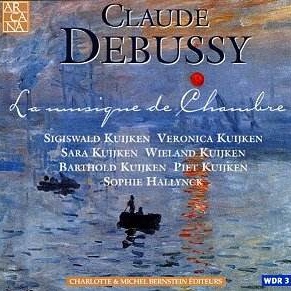
Debussy: String Quartet; Cello Sonata; Syrinx; Sonata for Flute, Viola, and Harp; Violin Sonata.
Sigiswald Kuijken, violin; Wieland Kuijken, cello; Barthold Kuijken, flute; Sara Kuijken, harp; Piet Kuijken, fortepiano; Kuijken String Quartet; no conductor.
Accent ACC 24352. Recorded 2010, Studio Soli Deo Gloria, Brussels. Booklet included. CD, 72:14.
There’s something almost utopian about the idea of a single disc gathering all of Debussy’s considerable chamber music—the early String Quartet alongside the late sonata triptych, with Syrinx floating in between like a solitary reed cry in the dark. The Kuijken family has done exactly that here, and on period instruments to boot. Before you reach for the remote, hear me out.
Period performance and Debussy is a genuinely interesting proposition. Not because the music demands historical rectitude the way Bach or Handel might, but because the sound world Debussy actually heard—lighter, more transparent, less upholstered—may have shaped his harmonic imagination in ways we’ve been unconsciously contradicting for decades on our big modern Steinways and dense-toned modern strings. The Érard piano used in the cello and violin sonatas, dating from 1894, is the key instrument here. I’ve sat at instruments like this. The action is quick, almost mercurial, and the upper register has a silvery delicacy that a concert Steinway simply cannot replicate without self-conscious restraint. When Piet Kuijken navigates the animando-agitato passage in the Cello Sonata—that churning, restless episode around 2:05—the textures breathe rather than press. You hear the counterpoint. Nothing smears.
Wieland Kuijken’s cello is eloquent throughout, though occasionally I wanted more risk, more rawness—the opening Prologue has a slightly contained quality, as if the players are being exquisitely careful rather than genuinely improvisatory.
The String Quartet is where the competition is most ferocious. Dozens of versions crowd the catalog, and the Alban Berg Quartet’s EMI recording has been my own touchstone for years—that combination of rhythmic snap and tonal richness is hard to dislodge. The Kuijkens begin more loosely, more conversationally, and at first this seems like a liability. It isn’t. Listen carefully to what happens when the development opens in the first movement: without any audible acceleration, the music tightens, gathers, becomes inexorable. It’s a structural insight, not merely a tempo effect. The second movement’s pizzicato passages have an almost gamelan-like shimmer on these instruments—lighter bowing contact producing overtones that simply don’t emerge the same way on modern strings.
Syrinx is something else again. Barthold Kuijken plays a Bonneville flute of 1910, and the tone is—well, not what we’re used to. Slightly edgier, less velvety. That misty, Impressionist haze we associate with the piece? Less of it here. I confess my first reaction was mild disappointment. But this is probably closer to what Debussy actually heard at the 1913 premiere, and after a few listenings the leaner sound begins to make its own argument—the melodic line emerges with greater clarity, the modal ambiguities are sharper, less dissolved in atmosphere.
The Sonata for Flute, Viola, and Harp is, for my money, one of the most original chamber works of the twentieth century—three timbres that have no business blending as perfectly as they do. Sara Kuijken’s harp is also an Érard, which gives the ensemble a remarkable homogeneity of period color. The opening pastorale has that quality of music drifting in from somewhere just out of reach, and the Kuijkens catch it without clutching at it—which is precisely the right approach.
Then there’s the Violin Sonata, Debussy’s last completed work, written when he was dying and knew it. Sigiswald Kuijken, the family’s most celebrated member, plays with a lean, searching intensity. The très animé finale—that perpetually shifting, almost delirious final movement—is pointed with rhythmic intelligence, the Érard’s lightness allowing the piano part to dart and flicker without overwhelming the violin. What the performance captures, and not every performance does, is the bleakness underneath the wit. This is not a cheerful piece. It is a man saying goodbye, brilliantly.
The recording is close and somewhat dry—not unpleasant, but one occasionally wishes for a touch more air around the instruments. The booklet is handsome, the annotations solid.
This is, in short, an indispensable collection. Not because every interpretation is definitively the finest available—the Quartet still has serious rivals—but because nowhere else do you get this particular overview, this particular sonic consistency, this particular intelligence applied to the whole of Debussy’s chamber output at once. Seek it out.