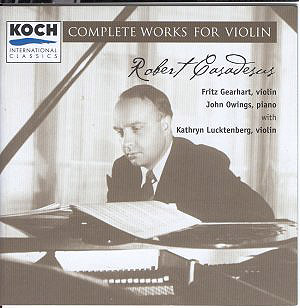
Casadesus: Violin Sonata no. 1; Violin Sonata no. 2; Suite for Two Violins; Hommage à Chausson
Fritz Gearhart, violin; John Owings, piano; Kathryn Lucktenberg, violin.
Koch International Classics KIC-CD-7528. Recorded at Beall Hall, University of Oregon.
Robert Casadesus occupies one of those peculiar niches in musical memory—celebrated pianist, largely forgotten composer—and this Koch release does something genuinely useful in disturbing that comfortable arrangement. Most listeners who know the name at all know it from CBS LPs: those luminous, slightly cool Mozart concerto recordings that seemed to arrive in living rooms with the regularity of milk deliveries through the sixties and seventies. Sony, inheriting the catalog, has been considerably less generous about carrying the flame. The composing Casadesus, meanwhile, has been left largely to fend for himself.
Which is a pity. A real one.
The Violin Sonata no. 1 of 1927—dedicated to his teacher Marie-François Emmanuel, that underappreciated figure who also shaped Honegger and Enescu—runs barely eleven minutes and spends nearly every one of them smiling. Ravel hovers nearby, unmistakably, but this isn’t pastiche. The opening movement has a particular quality of Mediterranean morning light, the kind that arrives at a sharp angle and makes everything look slightly more vivid than it actually is. Fritz Gearhart finds the singing line here naturally, without pressing, and John Owings keeps his touch appropriately transparent—you can hear the piano’s upper partials without the lower strings muddying things. Casadesus writes idiomatically for both instruments, which isn’t always a given with pianist-composers who sometimes quietly favor themselves.
Fourteen years separate the two sonatas, and the distance shows.
The Violin Sonata no. 2 of 1941—also dedicated to Zino Francescatti, as is the Hommage à Chausson—has absorbed something harder and more syncopated into its bloodstream. The Allegretto has a jazzy, slightly raffish quality that made me think, oddly, of Constant Lambert in his more Francophile moods: Marseilles back-streets, as someone once put it, lit by Provençal sun. The Allegro molto that follows doesn’t let up. Gearhart attacks it with genuine bite, the bow pressure noticeably firmer, the tone edgier at the upper end of the E string. This isn’t a comfortable sonata, and the performers seem to understand that comfort isn’t what’s being asked of them.
The Suite for Two Violins (1944) brings Kathryn Lucktenberg into the picture for the disc’s most substantial single span—fifteen minutes across six movements. Two violins together can produce a peculiar kind of inwardness, a chamber music that seems to fold back on itself, and Casadesus leans into that quality for much of the work’s middle section. But the finale—a peppery, intellectually high-spirited thing that I can only describe as a hoedown filtered through the Conservatoire—blows the solemnity away entirely. Gearhart and Lucktenberg are well matched in timbre, their intonation secure even through the trickier double stop passages.
Then there is the Hommage à Chausson (1955). Written for the centenary, built on the notes C-H-A-U-S-S-O-N, it opens as though it will be a soulful, perhaps slightly self-conscious elegy—widow’s weeds, one might say. It isn’t, quite. The opening soliloquy yields to a tripartite scherzo that accelerates with something close to passion, and the transformation is the most surprising moment on the disc. Gearhart handles it beautifully, the vibrato widening perceptibly as the emotional temperature rises.
Koch’s documentation is, as often with this label, exemplary—the booklet a model of what such things can be. The recording, made at Beall Hall at the University of Oregon, captures the performers in a space that’s intimate without being claustrophobic, the piano slightly back in the image, which is exactly right for this music.
Casadesus the composer won’t displace Casadesus the pianist in the history books. But this is warm, accomplished, genuinely Gallic music—Mediterranean in disposition, technically assured, emotionally unpretentious—and it deserves to be heard. Gearhart, Owings, and Lucktenberg make a strong case. So does Koch, for releasing it at all.