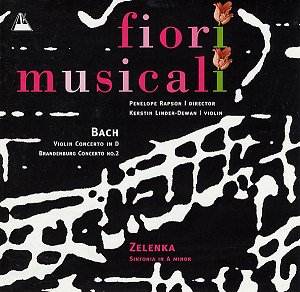
Bach: Violin Concerto in D Minor, BWV 1052 (reconstructed Linder-Dewan); Zelenka: Sinfonia in A Minor; Bach: Brandenburg Concerto no. 2
Kerstin Linder-Dewan, violin; Fiori Musicali; David Staff, trumpet; Jonathan Bates, conductor.
Meridian CDE 84567. Recorded live, March 14–15, 2003, Stationers’ Hall, London. Program notes by Richard Wigmore. CD, 68:22.
The whole business of reconstructing Bach’s lost violin concertos from their keyboard transformations remains a contentious affair—and probably always will. Here we have Kerstin Linder-Dewan’s attempt at BWV 1052, that magnificent D minor work we know primarily as a harpsichord concerto but which almost certainly began life as something else entirely. Ferdinand David tried his hand at it in 1837, and others have followed with varying degrees of conviction.
Linder-Dewan’s version proves surprisingly persuasive. She avoids the trap of merely transcribing keyboard figuration back onto the violin—there’s genuine thought here about what constitutes idiomatic string writing in Bach’s instrumental language. The rapid passagework in the outer movements sits naturally under her fingers, and she manages the crucial dialogue between soloist and ripieno with real understanding of Bach’s architectural principles. One doesn’t spend the performance wishing for the familiar harpsichord articulation, which is perhaps the highest compliment one can pay such an endeavor.
Her playing itself is stylish without being precious. The slow movement—that extraordinary meditation—unfolds with appropriate gravity, though I’d have welcomed slightly more tonal variation in the long-breathed phrases. Still, these are minor quibbles when set against the general accomplishment.
The Zelenka Sinfonia in A Minor offers welcome relief from the usual Baroque suspects. Jan Dismas Zelenka remains criminally underperformed, despite Bach’s evident admiration for him—he thought enough of the Bohemian’s work to have Wilhelm Friedemann copy out the Magnificat in D as a compositional study. This five-movement sinfonia shows why. Yes, there’s Vivaldi’s shadow over the whole enterprise, but Zelenka’s harmonic language has its own peculiar astringency.
The program notes make rather too much of supposed geographical parallels—comparing the Aria da Capriccio‘s “bleakness” to Bohemian mountain regions and thence to Dvořák’s Cello Concerto strikes me as the sort of fanciful extrapolation that does nobody any favors. The music speaks perfectly well on its own terms: vigorous outer movements framing some genuinely affecting slow music.
Fiori Musicali—six violins, two violas, two cellos, double bass, and appropriate continuo—play with considerable freshness and imagination. They’re a listening ensemble; you can hear them responding to each other, adjusting, breathing together. Not everything is perfectly tidy, and one suspects another few rehearsals might have eliminated some ragged ensemble in the tutti passages. But there’s an alertness here that compensates for occasional technical untidiness.
The real glory of this disc, though—and I say this with no disrespect to Linder-Dewan’s considerable achievements—is David Staff’s trumpet work in the Second Brandenburg. What playing! He modifies dynamics even while producing that searing, clarino brilliance the part demands, navigating Bach’s merciless tessitura with seemingly effortless security. The notorious high F sounds like it costs him nothing at all. This is trumpeting of the old school, magnificent and unafraid.
The Stationers’ Hall acoustic serves these performances well—warm without being muddy, spacious without losing detail. The engineering captures the ensemble’s transparency admirably.
For the Bach reconstruction alone this disc merits investigation. That it also offers committed Zelenka and truly exceptional Brandenburg trumpeting makes it considerably more than a scholarly curiosity.