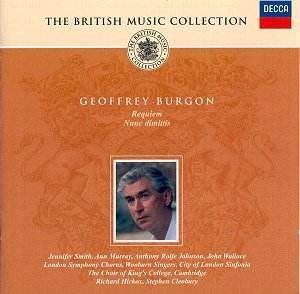
Burgon: Requiem; Nunc Dimittis
Jennifer Smith, soprano; Ann Murray, mezzo-soprano; Anthony Rolfe Johnson, tenor; City of London Sinfonia; Richard Hickox, conductor.
Decca 452 895–2. Recorded 1981, [venue]. CD, 54:00.
Geoffrey Burgon occupies an odd—some might say uncomfortable—position in British music. He made his name writing those haunting television scores that lodged themselves in the collective consciousness: Brideshead Revisited, Tinker, Tailor, Soldier, Spy. Exquisite stuff, certainly. But when a composer becomes famous for three-minute miniatures accompanying Oxford’s dreaming spires, what happens to his larger ambitions?
This Decca reissue from their British Music Collection gives us both Burgons: the 1976 Requiem that announced his arrival as a “serious” composer, and the Nunc Dimittis that became inseparable from television’s golden age. The juxtaposition is instructive, if not entirely flattering to the larger work.
The Requiem is massively competent. Burgon, coming late to full-time composition after years as a trumpeter, handles his forces with remarkable assurance—the orchestration never muddy, the choral writing always idiomatic, the solo lines expertly judged for their dramatic effect. Richard Hickox leads a performance of palpable commitment, the 1981 recording capturing everything from the opening’s ethereal pianissimos to the thunderous Dies Irae with its stereophonically thrilling antiphonal kettledrums.
Jennifer Smith carries the lion’s share of solo work, negotiating the soprano part’s vertiginous leaps with magnificent security. Those intervals—Burgon loves his wide, exposed jumps—would undo a lesser singer. Ann Murray brings her considerable authority to what was originally conceived as a male role (no stranger to trouser roles, she makes it entirely her own). Anthony Rolfe Johnson, who premiered the work five years earlier at Hereford Cathedral, displays the kind of intimate understanding that comes from living with music over time.
But here’s the difficulty. The Requiem is very much of its time—blocks of textured sound, the lingua franca of mid-1970s British composition. Burgon had the courage, or perhaps the instinct, to employ major and minor triads when such things were still somewhat suspect in certain circles. This almost makes the work seem prescient now, with minimalism and the return to tonality just around the corner. Almost.
The problem is that Burgon’s ambitions seem to outreach his materials. The Dies Irae thunders impressively, yes, but one keeps waiting for something more—a melodic profile that lodges in memory, a harmonic progression that surprises, a structural gesture that transcends competence. The work unfolds with professional authority but little genuine urgency. It’s the kind of piece that makes a superb impression at a cathedral premiere, gets recorded once by distinguished forces, then quietly recedes from the repertoire.
The Nunc Dimittis is another matter entirely. Three minutes, a boy treble floating over sparse textures, John Wallace’s trumpet adding its distinctive color—this is Burgon at his most distilled and effective. Thomas Hopkinson’s 1996 recording with Stephen Cleobury and the King’s College forces captures exactly that quality of suspended time the music requires. Far more idiomatic than Lesley Garrett’s soprano version (mentioned in the notes), this performance understands that the piece isn’t about vocal display but about creating a particular atmosphere, a specific emotional state.
And there’s the rub. Burgon’s miniaturist instincts—his gift for the perfectly judged gesture, the memorable melodic fragment—serve him far better than his attempts at large-scale architecture. The Nunc Dimittis has entered the repertoire in a way the Requiem never quite has. One could argue about what constitutes “serious” composition, but the music itself renders such arguments moot.
Decca’s reissue sounds excellent, though at 54 minutes it’s not exactly generous. They could have squeezed in the later Magnificat Burgon wrote to partner the Nunc Dimittis, but apparently it sits uncomfortably with its companion—and perhaps the Nunc Dimittis is best heard in its original, stand-alone conception anyway.
This disc serves as a valuable document of British music in the late twentieth century, capturing both the ambitions and the limitations of a talented composer trying to navigate between the demands of “serious” composition and his own natural gifts. That the shorter work succeeds more completely than the longer one tells us something about Burgon—and perhaps something about the state of British music in that particular moment. Hickox and his forces give us the Requiem at its best. Whether that’s quite good enough remains an open question.