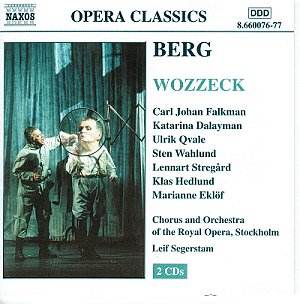
Berg: Wozzeck
Carl-Johan Falkman, baritone; Katarina Dalayman, soprano; Ulrik Qvale, tenor; Lennart Stregård, bass; Klas Hedlund, tenor; Royal Stockholm Philharmonic Orchestra; Leif Segerstam, conductor.
Naxos 8.660076–77. Recorded live, [dates], [venue]. Opera; no translation provided. 2 CDs.
One forgets, sometimes, how much sheer noise Berg packed into those opening bars of Wozzeck—not just volume, but textural density, the kind that makes you lean forward. Leif Segerstam understands this. His Stockholm forces attack the score with a clarity that borders on surgical, yet never feels clinical. The winds and brass emerge with unusual prominence here, something that will either delight or irritate depending on your tolerance for unconventional balances. I found it revelatory.
Segerstam has made some eccentric choices over the years—his Sibelius cycle provoked more than a few raised eyebrows—but this Wozzeck strikes me as the work of a composer-director who has lived inside Berg’s sound world long enough to know which details matter. The interludes, those crucial structural hinges, are paced with meticulous attention to Berg’s markings. Not approximately. Exactly. The great D minor interlude that serves as the opera’s emotional summing-up doesn’t wallow in string tone the way some performances do, yet loses nothing in expressive weight. If anything, the leaner texture lets the contrapuntal lines breathe.
What really distinguishes this performance, though, is the singing—actual singing, not the half-spoken approximations that sometimes pass for Sprechstimme interpretation. Carl-Johan Falkman’s Wozzeck traces the character’s psychological disintegration with frightening conviction. His “Wir arme Leut” isn’t barked or declaimed; it’s sung with a kind of desperate lyricism that makes the social critique all the more piercing. In the final tavern scene, when Margret notices the blood, his response carries genuine terror—not theatrical terror, the real thing.
Katarina Dalayman’s Marie matches him in dramatic intelligence. Her “Meinetwegen, es ist Alles eins” at the end of Act One contains multitudes: resignation, defiance, self-loathing, all compressed into a single phrase. This is singing that trusts Berg’s vocal lines to do their work without editorial underlining.
The supporting cast maintains this standard. Ulrik Qvale’s Captain navigates the treacherous falsetto passages without toppling into caricature—no small achievement. Lennart Stregård’s Doctor is properly unhinged, dreaming of scientific immortality while conducting mad experiments. Klas Hedlund’s Andres can’t quite erase memories of Fritz Wunderlich in the role for Böhm, but then who could?
The recording itself favors a somewhat forward vocal placement, which may trouble listeners accustomed to Dohnányi’s more blended Decca sound with Anja Silja. But Berg’s orchestration is so dense, so layered, that different balances reveal different aspects of the score. Stage noise is present but minimal—apparently this was a fairly stripped-down production—and less intrusive than in Abbado’s live DG set.
The Naxos documentation follows their opera series standard: original German text only, no translation, but detailed scene-by-scene synopsis with cue points. Keith Anderson’s notes cover the essentials. At superbudget price, with no coupling, this faces stiff competition from Böhm (now with the two-act Lulu) and especially Mitropoulos’s blazing 1951 performance, which Sony couples with Erwartung and Krenek’s Symphonic Elegy. But this Stockholm performance earns its place through sheer musical intelligence and dramatic conviction.
The precision never feels pedantic. The clarity never feels cold. Segerstam and his forces have given us a Wozzeck that reminds us why Berg’s masterpiece remains so unsettling—and so necessary—nearly a century after its premiere. Worth having regardless of what else sits on your shelf.