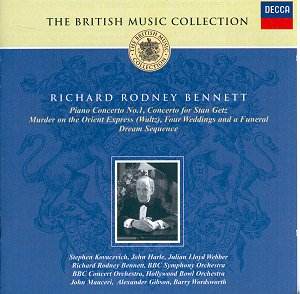
Bennett: Piano Concerto; Concerto for Stan Getz; Film Music Excerpts; Dream Sequence
Stephen Kovacevich, piano; John Harle, saxophone; Julian Lloyd Webber, cello; BBC Symphony Orchestra; Sir Alexander Gibson, conductor; Barry Wordsworth, conductor; John Mauceri, conductor; Hollywood Bowl Orchestra.
Decca [catalog number not provided]. Recorded various dates, various venues. Compilation. CD.
Richard Rodney Bennett—who died in 2012, though this Decca compilation dates from 2002—never quite got his due from either camp. Too jazzy for the serialists, too cerebral for the film crowd. This disc makes the case, somewhat haphazardly, for his divided genius.
The Piano Concerto from 1968 is the real treasure here. Stephen Kovacevich’s performance, originally on EMI, sounds remarkably fresh—his touch in the first movement’s refined filigree has that peculiar transparency he brought to Bartók, each note placed with jeweler’s precision. Bennett’s serial procedures sit lightly on the surface; underneath, there’s a genuine lyricism that never apologizes for itself. The quick movements pulse with dance rhythms that owe more to Stravinsky than to Schoenberg, and the orchestration—spare, carefully balanced—lets you hear everything. Sir Alexander Gibson and the BBC Symphony give it proper weight without heaviness.
Why does the annotation call this “Piano Concerto No. 1”? Bennett never wrote a second. Sloppy.
The Concerto for Stan Getz, composed in 1990, treads dangerous ground. Homages to jazz legends usually collapse into pastiche or condescension. Bennett avoids both traps—barely. John Harle’s saxophone tone is creamy, perhaps too smooth for the idiom Bennett’s invoking, but the piece itself shows real affection without mimicry. The harmonic language is richer, less ascetic than the Piano Concerto; Bennett had traveled far in those twenty-two years. Barry Wordsworth conducts with appropriate swing, though the BBC Symphony sounds tentative in the syncopations.
Then comes the film music, and we’re in a different universe entirely.
That waltz from Murder on the Orient Express—yes, it’s gorgeous, yes, it’s famous, but what’s it doing here? John Mauceri and the Hollywood Bowl Orchestra play it with appropriate schmaltz. The snippet from Four Weddings and a Funeral is charming fluff, nothing more. These pieces show Bennett’s facility, his professionalism, but not his depth. They’re the equivalent of Walton’s film scores, though without quite that level of distinction.
Dream Sequence, with Julian Lloyd Webber’s cello and Bennett himself at the piano, arranges three standards—we’re not told which ones, another annotation failure. Lloyd Webber plays with his usual warmth, perhaps excessive warmth; the vibrato threatens to overwhelm Bennett’s tasteful harmonizations. Pleasant enough for a birth celebration (whose birth? the notes don’t say), but lightweight.
The real problem with this compilation is what’s missing. Bennett’s Spells, that extraordinary choral-orchestral work, was on Argo years ago—out of print at the time of this release. The Aubade, Calendar, Commedia IV for brass quintet: all unavailable. Instead we get film music excerpts and a cello bagatelle. The disc runs under sixty minutes. Decca could have given us a proper survey; instead they’ve assembled a sampler that neither satisfies the serious listener nor provides adequate introduction to Bennett’s range.
Kovacevich’s performance alone justifies ownership—that Piano Concerto deserves to be in the repertory, and this remains its finest release. But what a missed opportunity. Bennett straddled two worlds with more grace than most composers manage in one, and this disc can’t quite decide which world it wants to inhabit.
A frustrating release: essential for the concerto, maddening for everything around it.