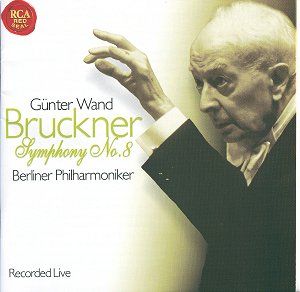
Bruckner: Symphony no. 8 in C Minor
Berlin Philharmonic Orchestra; Günter Wand, conductor.
RCA Red Seal 74321 82866–2. Recorded live, January 2001, Berlin Philharmonie. CD, 87:07.
There are recordings that arrive on one’s desk with the weight of history already settling upon them—and then there are those that actually earn it. This live traversal of Bruckner’s Eighth, set down in the Berlin Philharmonie over four January evenings in 2001, belongs emphatically to the latter category. Wand was eighty-nine. He had been conducting this symphony for fifty-two years. And here, near the end (he would die just over a year later), he hands us something that feels less like an interpretation than a final reckoning.
The first thing one notices—it’s impossible not to—is the sheer sonic heft of the Berlin strings. Not plush in that generalized, homogenized way one sometimes encounters, but richly textured, with the basses providing a foundation so secure you could build cathedrals on it. Which is precisely what Bruckner did, of course. The upper strings have that particular lustrous glow that only this orchestra seems to achieve consistently, and Wand knows exactly how to deploy them. Listen to the way the violins emerge from the opening’s primordial murmur—not forced, not pushed, but simply allowed to materialize with an inevitability that seems to bypass human agency entirely.
The brass deserve their own paragraph. They always do in Bruckner, but especially here. Golden, heroic, yet never—and this matters enormously—strident or forced. The Berlin brass section pours out torrents of sound with a kind of aristocratic ease that one hears nowhere else, and Wand harnesses this power with the wisdom of someone who knows that genuine majesty requires no shouting. The balance is impeccable throughout: harps placed just so (neither recessed nor spotlit), woodwinds given their proper due in those rare moments when Bruckner remembers they exist, and a timpanist who understands the difference between dynamic and merely loud.
But technique, however exalted, remains merely artistry. What lifts this performance into rarefied air is the architectural command Wand brings to nearly ninety minutes of music that can, in less experienced hands, seem to meander or fragment. The first movement unfolds with prodigious power—dramatic without being melodramatic, intense without hysteria. Those great climaxes arrive with the force of natural phenomena, yet the coda dissolves into a melancholy so profound it seems to question everything that preceded it. The "scherzo" drives forward with all necessary urgency, then relaxes into a trio of such tender lyricism that one hears Bruckner’s debt to Schubert (another composer Wand conducted with rare insight) written in every phrase.
If I had to choose one word—and I resist reductionism, but sometimes clarity demands it—that word would be “patient.” Not slow, mind you. Patient. There’s a crucial difference. Wand knows this music so intimately that he can afford to let it breathe, to unfold at its own organic pace without the nervous fussing that mars so many performances. The great terraced climaxes, when they come, land with devastating impact precisely because they haven’t been anticipated or telegraphed. The final outpouring at 21:27 is overwhelming—not through volume alone, but through the accumulated weight of everything that has come before.
Those last five minutes: the Wagner tubas in the coda make their magisterial contribution with a solemnity that approaches the numinous. The Berlin players respond with eloquence of the highest order. This is conducting that transcends craft and enters the realm of wisdom.
One might worry that after such an "Adagio", the "finale" would feel anticlimactic. It doesn’t. Wand unleashes it with tremendous power, but more importantly, he solves the structural problem that bedevils this movement—its tendency toward the episodic. Through careful pacing and absolutely convincing transitions, he makes Bruckner’s logic audible, even inevitable. The coda, built from 22:52 onward with magnificent cumulative force, brings the symphony to a conclusion that is simultaneously triumphant and deeply serious. Regal, yes. Tumultuous, certainly. But also profoundly earned.
I had initially planned to compare this recording with Wand’s own 1993 NDR account, with Karajan’s final Berlin traversal, perhaps with Giulini or Jochum. But the more I lived with these discs, the more such comparisons seemed beside the point. This is a performance of such integrity, such complete absorption in the music’s deepest purposes, that it demands to be encountered on its own terms. The RCA engineers have captured it all with admirable clarity and warmth—the acoustic of the Philharmonie serving the music ideally.
I don’t believe Wand’s death during my time with this disc has colored my judgment. But I do think this release stands as a fitting capstone to a lifetime’s engagement with this composer. There have been many fine recordings of the Eighth over the decades. A handful of great ones. This belongs among them—and may well come to be regarded as the benchmark against which future accounts are measured. It is, quite simply, indispensable: for Brucknerians, for admirers of great orchestral playing, for anyone who cares about what conducting at its highest level can achieve.
A towering achievement, and almost certainly one of the most notable orchestral releases we shall hear this year.