
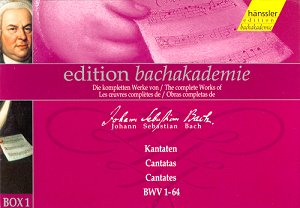
Bach: Cantatas, Volume 1
Gächinger Kantorei; Bach-Collegium Stuttgart; Helmut Rilling, conductor.
Hänssler 92.561. Recorded 1968–85. 20 CDs.
Rilling’s cantata project—begun in the late 1960s, completed nearly two decades later—occupies a peculiar position in the Bach discography. Not quite the pioneering archaeological dig that Harnoncourt and Leonhardt undertook, not quite the comfortable old-fashioned approach of Karl Richter. Something in between, which is both its strength and its limitation.
The sheer scale demands respect. Twenty discs covering BWV 1 through 64 (with gaps for spurious works), representing roughly a third of the complete cycle. More than forty vocal soloists. Recording sessions spanning from 1968 to 1985, which means the earliest sessions predate the period-instrument revolution, while the latest catch its first wave. You can hear the sonic aesthetic shift subtly across the years—early recordings with that slightly boxy German studio sound, later ones opening up into more spacious acoustic environments.
Rilling’s fundamental choice—modern instruments, substantial forces, female sopranos and altos—places him firmly in what we might call the humanist tradition. His Gächinger Kantorei sings with a fullness and warmth that the historically informed crowd would find excessive. Take the opening chorus of BWV 19, “Es erhub sich ein Streit“—those horns blaze, the timpani crack with almost Beethovenian force, the voices surge forward in great waves. It’s magnificent, unquestionably. Whether it’s Bach is another question entirely.
But then—and here’s where simple categorization fails—listen to the “Weinen, Klagen, Sorgen, Zagen” chorus from BWV 12. Seven minutes of descending chromatic pain, the music that would become the Crucifixus of the B Minor Mass. Rilling’s choir achieves something remarkable here: a transparency, a subtle gradation of color that belies the supposedly “blunt” modern-instrument approach. The basses don’t overwhelm, the sopranos don’t shriek. There’s an architectural understanding of how Bach builds these massive structures from interlocking lines.
The instrumental playing varies considerably. Sometimes the strings sound merely competent, workmanlike—that opening sinfonia of BWV 4, “Christ lag in Todes Banden,” feels rushed, the vibrato too thick, the articulation muddy. Other times, as in the oboe obbligato that threads through BWV 21, you encounter playing of real poetry. The problem is inconsistency. With sessions scattered across seventeen years, using different orchestral personnel, the instrumental standard lurches from adequate to outstanding without predictable pattern.
Now, those forty-plus soloists. This becomes genuinely problematic. Arleen Augér appears, radiant and pure-toned. Helen Donath shows up with vibrato that makes you wince. Adalbert Kraus—who sounds uncannily like Peter Schreier at times—delivers aria after aria with intelligence and style. Then someone like Helen Watts, for all her reputation, wobbles through “Menschen, glaubt doch dieser Gnade” in BWV 7 with such pronounced vibrato that the line nearly disintegrates.
The bass soloists present a particularly instructive case study. Philippe Huttenlocher, Walter Heldwein, Siegmund Nimsgern—all capable, all professional. Then Fischer-Dieskau arrives for BWV 56, “Ich will den Kreuzstab gerne tragen,” and you remember what great singing actually means. This was his fourth performance of the work (he’d return for a fifth), and by 1985 or thereabouts the voice had darkened, lost some flexibility. No matter. The intelligence, the word painting, the way he shapes that dialogue with the oboe in the third section—it’s on another plane entirely. One wishes Rilling had secured him for more cantatas, though of course Fischer-Dieskau’s fees and schedule made that impractical.
Peter Schreier, appearing several times, brings his customary clarity and spiritual depth. His “Geliebter Jesu, du allein” in BWV 16 reminds you why he became the definitive Evangelist of his generation. The voice floats, never forces. Every word matters.
The tempos perplex. Rilling often chooses the road less interesting—that opening chorus of BWV 41 races along at breakneck speed, giving the music a breathless energy but sacrificing some of the chorale’s inherent gravitas. Then he’ll take something like the aria from BWV 21 at a crawl, though Augér’s sensitivity almost makes you forgive the sluggish pace. Almost.
What’s missing throughout is the sense of these works as liturgical objects, pieces designed for specific Sundays in the church calendar, sermons in sound. Rilling presents them as concert works, polished and presentable. The rough edges get sanded down. The theological urgency that courses through even Bach’s most routine cantatas—that weekly miracle of turning scripture and chorale into transcendent music under impossible deadlines—recedes behind radiant surfaces.
And yet. That choir. When Rilling gets the balance right, when the soloists rise to the occasion, when the engineers capture the sound properly, these performances can genuinely move. The architecture becomes clear, the counterpoint transparent, the spiritual content—if not exactly liturgical—at least present and accounted for.
Comparing this to Harnoncourt/Leonhardt (still the only other complete cycle available when this review was written, with Leusink’s budget entry just emerging and Suzuki and Koopman in progress) reveals fundamentally different philosophies. The Teldec set prizes dramatic intensity and period sonority over tonal beauty. Rilling inverts those priorities. Neither approach is “correct“—Bach didn’t leave us instructions, and the performance practice of 1720s Leipzig remains largely unknowable.
For someone beginning to explore the cantatas, this set presents real difficulties. The inconsistency of soloists, the variability of recording quality, the sheer sprawl of forty-plus hours across the complete cycle—it’s a lot to navigate. Cherry-picking individual cantatas based on cast makes more sense than systematic listening.
But dismiss Rilling entirely? That would be foolish. These recordings preserve an approach to Bach that’s now largely vanished, swept away by the period-instrument tide. In another twenty years they may soun
