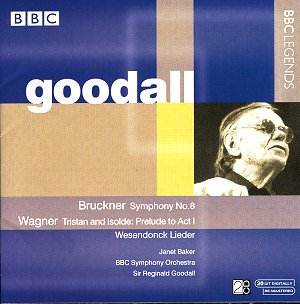
Goodall: Tristan Prelude; Wesendonck Lieder; Bruckner Symphony no. 8 in C Minor
Janet Baker, mezzo-soprano; BBC Symphony Orchestra; Reginald Goodall, conductor.
BBC Legends BBCL 4000–2. Recorded live, 1969, 1971, Royal Albert Hall and Royal Festival Hall, London. No texts or translations included. CD, 89:00 approx.
The BBC has done us a service—though not an unambiguous one—in releasing these live performances from Reginald Goodall’s brief moment of wider recognition. Brief, I say, because Goodall remained stubbornly marginal despite the Ring cycles at the Coliseum that made certain critics (myself occasionally among them) speak in hushed tones about revelatory tempi and Wagnerian authenticity. Whether that reputation survives close scrutiny of this Eighth Symphony is another matter entirely.
The 1969 Proms recording catches Goodall in characteristic form: spacious, deliberate, sometimes maddeningly so. His eighty-nine minutes feels longer—not because the performance drags exactly, but because the conductor seems determined to make us contemplate each phrase as if it were carved in granite. This works beautifully in the "Adagio", where Goodall’s architectural sense proves genuinely impressive. The great climaxes emerge with a kind of tectonic inevitability, and if the BBC Symphony doesn’t quite possess the burnished string tone of the Vienna Philharmonic, they play with evident commitment and surprising precision given the treacherous acoustics of the Albert Hall.
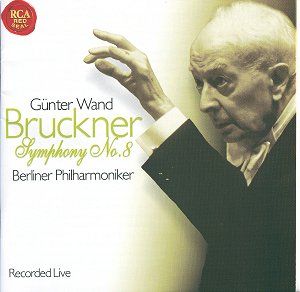
But commitment isn’t everything. The first movement lacks atmosphere—partly the fault of the rather boxy recorded sound, partly those maddening coughs that punctuate the exposition like unwelcome grace notes. More troubling is Goodall’s reluctance to find any real tension in the music’s harmonic ambiguities. Where Günter Wand (whose recent RCA recording sets the current standard) shapes phrases with subtle rubato that reveals Bruckner’s connection to the Viennese waltz tradition, Goodall simply proceeds. The totenuhr coda has appropriate darkness, yes, but it arrives without the sense of hard-won resolution that makes this moment devastating.
The "scherzo" fares better. Goodall understands its peasant strength, and the trio lilts nicely—though I wish the horns had been more forward in the mix, since their hunting calls provide essential color contrast.
It is the "finale" that troubles me most. Goodall’s monumental approach should theoretically suit Bruckner’s towering coda, where all four movements’ themes combine in contrapuntal apotheosis. And indeed, when we arrive at that moment, the performance achieves genuine power. But getting there proves arduous. The movement needs more attack, more rhythmic bite—qualities that even the most spacious interpretation (think Celibidache) can accommodate. Goodall’s literalism robs the music of its dialectical tension, that sense of struggle toward transcendence that makes the Eighth Bruckner’s most ambitious symphonic statement.
Now for the compensation.
The Wagner items, recorded two years later at the Festival Hall, remind us why Goodall’s reputation rested primarily on this repertoire. The Tristan Prelude has exactly the right combination of mystery and erotic yearning—that peculiar Goodall quality of making time itself seem suspended. The orchestra sounds more comfortable here, the recorded sound warmer and more atmospheric. You can actually hear the cellos’ portamento in the opening phrase, that slight slide between notes that modern orchestras have mostly abandoned but which seems essential to this music’s sensuality.
And then there is Janet Baker in the Wesendonck Lieder. Lord, what a voice she had in 1971—that distinctive timbre, somewhere between mezzo richness and contralto depth, perfectly suited to these songs’ ambiguous emotional territory. “Träume” achieves the kind of inward intensity that eludes most singers, and “Im Treibhaus” has genuine desolation without becoming maudlin. Goodall accompanies with unusual sensitivity, allowing Baker to shape phrases freely while maintaining orchestral cohesion. The only serious complaint: BBC Legends couldn’t be bothered to include texts and translations, a penny-pinching decision that borders on contempt for the listener.
So where does this leave us? The Symphony no. 8 belongs to completists and Goodall devotees—it documents an important performance without displacing any current recommendations. But the Wagner? That’s worth the price of admission. Baker at her peak, Goodall in his element, both captured in acceptable if not spectacular sound.
One disc to treasure, one to admire respectfully from a distance.
Terry Barfoot