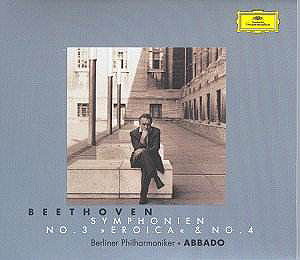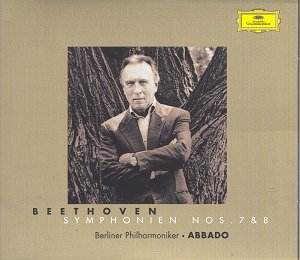
Beethoven: Symphony no. 7; Symphony no. 8
Berlin Philharmonic; Claudio Abbado, conductor.
Deutsche Grammophon 000000. Recorded 1999–2000, Philharmonie, Berlin. CD.
The Berlin Philharmonic can play anything, of course. That’s never been the question. Under Abbado’s direction in these 1999–2000 recordings of Symphony no. 7 and Symphony no. 8, they prove once again the technical mastery that has been their calling card for more than a century. Every entrance is clean, every dynamic gradient calibrated with Swiss watchmaker precision, every phrase shaped with that particular combination of warmth and brilliance that remains the orchestra’s signature sound world.
And yet something essential has gone missing.
Abbado, we’re told in the promotional material, has been influenced by the period-instrument movement in his approach to this Beethoven cycle. Fair enough—though one wonders what exactly this means in practice. The tempos in the Seventh’s opening Poco sostenuto don’t strike me as particularly revelatory; they’re brisk without being breathless, measured without being stolid. The articulation throughout shows careful attention to Beethoven’s markings, yes, but so did Toscanini’s sixty years ago, and Weingartner’s before that. The notion that we’ve only recently discovered how to read Beethoven’s scores is one of the more persistent myths of our time.
What distinguishes these performances—if that’s the right word—is a kind of studied neutrality, a determination not to impose interpretive personality on the music. The Seventh’s Allegretto unfolds with immaculate attention to the written accents and tenuto markings, the cumulative effect carefully built through dynamic terracing. But where is the inevitability, that sense of tragic procession that makes this movement so devastating in the right hands? Klemperer found it. Furtwängler certainly found it. Even Karajan, for all his occasional glibness, understood that this music needs to breathe, to expand and contract with something approaching human respiration.
The "finale" of the Seventh proceeds at a tempo that initially seems promising—quick enough to generate excitement, not so quick as to turn the thing into a mere display of virtuosity. The strings manage Abbado’s pace admirably, their articulation crisp even in the most demanding passages. Yet Carlos Kleiber’s recording with the Vienna Philharmonic (admittedly one of the great Beethoven performances on disc) reveals what’s missing: that ineffable quality of lift, of dance, of sheer rhythmic buoyancy that makes this movement irresistible. Kleiber also brings out inner voices—the bassoon and pizzicato cello dialogues around measure 67, for instance—with a clarity that makes them seem like natural discoveries rather than spotlit revelations.
The engineering doesn’t help matters. Deutsche Grammophon has created what I can only describe as a peculiarly two-dimensional soundscape, in which every section of the orchestra seems painted onto an aural canvas rather than arranged in three-dimensional space. It’s not crude spotlighting—nothing so vulgar—but rather a flattening of perspective that removes the natural depth one expects from a symphony orchestra recording. Perhaps this is meant to serve Abbado’s vision of transparency, but the effect is oddly claustrophobic, particularly in forte passages where the sound becomes congested despite the obvious care taken with balance.
The Eighth fares even less well. Abbado’s decision to use reduced forces makes little sense to me—certainly Beethoven didn’t call for them, and the supposed gain in clarity proves illusory. Try to hear the second violin and viola semiquavers against the main theme in the first movement. They should provide a destabilizing undercurrent, a hint of unease beneath the surface jollity. They’re barely audible here, whereas Toscanini’s fifty-year-old mono recording captures them perfectly, and with them, the essential character of the movement.
More troubling is what happens—or rather, doesn’t happen—in the development section of that first movement. Beethoven’s harmonic progressions here tighten like a vise, building tension that makes the return to the exposition a moment of genuine relief and joy. Abbado glides through these passages with such equanimity that the architecture collapses. The recapitulation arrives not as release but as mere continuation, robbing Beethoven’s formal design of its psychological power.
Throughout both symphonies, Abbado maintains a curious consistency in his treatment of phrase endings, generally avoiding the ritenutos and rallentandos that many conductors employ (sometimes, admittedly, to excess). This asceticism might be defensible as a principled approach—except that at the very end of the Eighth, where Beethoven’s abrupt conclusion is part of the joke, Abbado suddenly indulges in a slight rallentando that undercuts the composer’s wit. It’s a small thing, perhaps, but symptomatic of a deeper problem: the lack of a coherent interpretive vision that might justify these choices.
The booklet notes include Abbado’s reflections on his admiration for Furtwängler and his qualified reservations about Toscanini (despite having studied with Hermann Scherchen, who championed Toscanini’s approach). Yet these recordings sound nothing like Furtwängler’s visionary, almost mystical Beethoven. If anything, they more closely approximate Toscanini’s clarity and forward momentum—but without the Italian maestro’s fierce dramatic instinct, his ability to make every bar count.
Some listeners, I suppose, will appreciate this reticence, this refusal to “interpret” in any overt sense. They will hear in these performances a kind of purity, a letting-the-music-speak-for-itself that respects Beethoven’s authority. I invite them to listen more carefully, and to ask themselves: whose Beethoven is this, exactly? Not Abbado’s, surely, for there’s too little personality here. But not really Beethoven’s either—for the composer’s markings, scrupulously observed though they may be, are only the beginning of the conversation, not its end.
The Berlin Philharmonic plays magnificently throughout. One could hardly expect otherwise. But magnificent playing in service of interpretive anonymity remains just that—anonymous.
After the final bars of the Eighth have sounded and the disc has spun to its conclusion, I found myself reaching not for another installment of this cycle but for Kleiber, for Furtwängler, for Scherchen himself—for any recording that might remind me why these symphonies matter, why they continue to speak to us across two centuries.
That’s not a trivial failure.