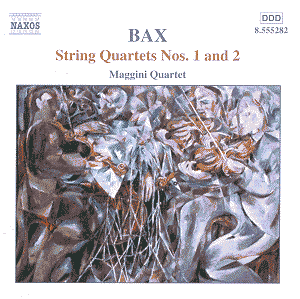
Bax: String Quartet no. 1; String Quartet no. 2
Maggini Quartet
Naxos 8.555282. Recorded [dates and venue not specified]. CD, 54:00
The First Quartet catches you off guard—not because it announces itself with some modernist manifesto, but because it doesn’t. Written in 1918, while the guns were still firing across the Channel, this three-movement work radiates a kind of stubborn, almost defiant joy. Bax seems to have turned his back on the trenches entirely, spinning out melodies with Dvořákian abundance, letting the harmony tease and shimmer without ever turning bitter.
The Maggini Quartet understands this implicitly. Their performance has the quality of spontaneous music-making—though of course it isn’t spontaneous at all, but rather the product of deep preparation worn lightly. Listen to how they shape the opening of the first movement: there’s a buoyancy in the articulation, a sense of forward motion that never feels rushed. The cellist anchors the texture without weighing it down, while the violins dance above with what sounds like genuine pleasure.
And that "Rondo" "finale"—well, there’s a tune at 5:22 (if you’re following along at home) that lodges itself in memory with alarming persistence. It’s one of those melodies that makes you wonder why Bax isn’t played more often. The spectral quality that emerges midway through the movement, that sudden shift in color and density, shows a composer who knows exactly what he’s doing, even when he’s ostensibly writing light music.
The disc itself is exemplary. Potton Hall has become something of a secret weapon for British chamber music projects, and this disc proves why. The acoustic provides warmth without bloom, clarity without glare. You can hear the rosin on the bow, the way each instrument sits in space—details that matter when the writing is as texturally intricate as Bax’s often is.
Then comes the Second Quartet of 1925, and we’re in different territory altogether.
This is music that demands something from you. Contemporary with the Second Symphony, it shares that work’s vertical complexity—lines piling atop lines, harmonies that refuse to settle into comfortable patterns. The melodic prodigality of the First Quartet has dried up; instead, we get a kind of rigorous argument, four voices working through problems that don’t admit easy solutions.
The Maggini players don’t try to pretty it up or make it more ingratiating than it is. They lean into the angularity, the moments where Bax seems to deliberately avoid the resolution you expect. There’s something almost Goossensian about this music—I kept thinking of Eugene Goossens’s By the Tarn, that same sense of a British composer wrestling with continental modernism and emerging with something that doesn’t quite sound like either tradition.
Is it as immediately appealing as the First? No, and it would be dishonest to pretend otherwise. This is music for listeners who’ve already made Bax’s acquaintance and want to explore the less sun-dappled corners of his output. But the Magginis make the strongest possible case for it, finding coherence in what could sound merely knotty, revealing an architecture that justifies the vertical complexity.
Lewis Foreman’s liner notes provide the necessary context—dates, circumstances, influences—without overexplaining. He trusts the listener to meet the music halfway.
The obvious comparison is with Chandos’s earlier recordings, which couple these works differently (the First with the Piano Quartet and Harp Quintet, the Second with the Piano Quintet). Those performances are fine, but the Naxos sound is superior, and having both quartets together makes programmatic sense. You hear the journey Bax traveled between 1918 and 1925, from sunshine to shadow, from melodic abundance to contrapuntal rigor.
If you don’t know Bax’s chamber music, start here. The First Quartet will win you over immediately; the Second will give you something to grow into. And both performances are unlikely to be bettered anytime soon.