
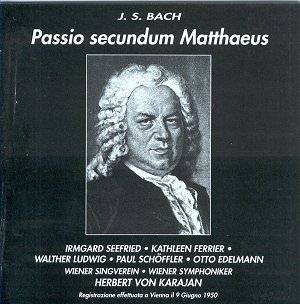
Bach: Saint Matthew Passion
Walther Ludwig, tenor; Paul Schöffler, bass-baritone; Irmgard Seefried, soprano; Kathleen Ferrier, contralto; Walter Berry, bass; Wiener Singverein; Vienna Philharmonic; Herbert von Karajan, conductor.
Urania [catalog number not supplied]. Recorded live, 1950, Vienna.
This live performance from Vienna’s 1950 Bach bicentenary festival arrives trailing clouds of historical interest—and considerable sonic compromise. Herbert von Karajan’s conception of Saint Matthew Passion belongs emphatically to its era, when Bach was still being dressed in late-Romantic upholstery, and one either accepts this premise or turns elsewhere.
The tempos are often leaden. Karajan’s chorales move with the gait of a funeral cortège, and the Wiener Singverein—Brahms’s old chorus, mind you—produces a thick, unfocused sound that obscures contrapuntal detail. Those sopranos! They scoop up to pitch with maddening consistency, as if the note centers were moving targets. The engineering places some crucial instrumental lines—particularly the oboe pairs—too far back in the aural frame.
Yet dismissing this set would be foolish.
What rescues the performance, beyond its documentary value, is the vocal casting. Paul Schöffler’s Jesus possesses genuine majesty, his bass-baritone combining authority with an almost tender resignation. Walther Ludwig proves himself a masterful Evangelist, nowhere more impressive than in the cock-crow sequence—Peter’s denial rendered with palpable dramatic tension, the weeping conveyed through vocal color rather than histrionics.
The young Walter Berry (only 21!) takes the small role of the High Priest with a security that hints at the major career to come. Irmgard Seefried sounds tentative in “Blute nur“—was she intimidated by her distinguished colleague?—but gains confidence as the aria unfolds. Her voice, noted for its particular lightness and charm, seems also to have been placed at some distance from the microphones.
Then there is Kathleen Ferrier.
Her “Erbarme dich” remains the performance’s undeniable summit. That distinctive contralto, with its extraordinary richness in the lower register and surprising bloom above the staff, invests every phrase with profound feeling that never tips into sentimentality. The anonymous violin soloist (presumably the orchestra’s leader) matches her poignancy measure for measure. This is singing of such intensity that one forgives much—the creaking floorboards, the coughs, the occasional throat-clearing audible between entries.
The duet “So ist mein Jesu” finds Seefried and Ferrier in gorgeous balance, both possessing the breath control to sustain Karajan’s glacial pacing. Even the chorus rises to something approaching eloquence here, their interjections demanding Jesus’s release genuinely dramatic.
One accepts the sonic limitations—this is, after all, a live document from 1950, and Urania’s restoration work proves competent if not miraculous. The real question is whether Karajan’s interpretive approach holds validity. By current standards of historically informed performance, it doesn’t. The textures are too opaque, the gestures too broad, the whole edifice too monumental.
But Ferrier died in 1953. This stands as one of the few complete recordings preserving her art in Bach’s greatest choral work. For that alone—and for Schöffler, Ludwig, and those moments when everything coheres—the set commands respect. Not a first choice for Saint Matthew Passion, certainly. But as a glimpse into midcentury performance practice, and as a tribute to a singer gone too soon, it merits attention.
The anniversary of Ferrier’s death approaches. These discs remind us why she hasn’t been forgotten.
Christopher Fifield’s original review deserves acknowledgment for its detailed documentation of the performance specifics.
