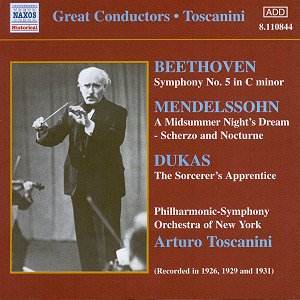
Beethoven: Symphony no. 5 in C Minor; Mendelssohn: A Midsummer Night’s Dream, "Scherzo"; Dukas: The Sorcerer’s Apprentice
New York Philharmonic; Arturo Toscanini, conductor.
Naxos Historical 8.111234. Recorded live, 1926–31, Carnegie Hall, New York. Transfers by Mark Obert-Thorn. CD.
Naxos concludes its documentary survey of Toscanini’s New York Philharmonic years with the 1931 Beethoven Symphony no. 5 in C Minor, and here at last we encounter something more than archival diligence. This performance—captured live at Carnegie Hall, complete with those Carnegie coughs that punctuate the first movement like gunfire—has genuine interpretive substance. Mark Obert-Thorn’s restoration work navigates the sonic compression admirably, though the optical film source material was always going to present challenges.
The performance itself is swifter than the 1933 remake that appeared earlier in this series, yet paradoxically more lyrical. Toscanini allows phrases to breathe here—not much, mind you, but enough to suggest he hadn’t yet calcified into the marble deity of later years. The first movement’s exposition repeat (which he would later abandon) gives the architecture proper weight. Those second-movement variations actually vary in character rather than merely tempo. The "finale" drives forward with characteristic Toscaninian steel, but listen to how the cellos sing in the second theme—there’s warmth beneath the velocity.
Now, about the couplings.
Three versions of the A Midsummer Night’s Dream "Scherzo". Three. The earliest, from 1926 for Brunswick, sounds tentative—lumpy is Jonathan Woolf’s apt description in the original MusicWeb review, and I won’t improve on it. Toscanini hadn’t yet learned to trust the recording horn, and it shows in phrasing that seems to second-guess itself. The 1929 Victor takes (both of them) find surer footing, though flutist John Amans must have wondered what he’d done to deserve this Groundhog Day treatment. The performances are virtually identical—same breakneck tempo, same whipcrack articulation, same sense that Mendelssohn’s fairy music has been conscripted into the Italian Army.
Paul Dukas’s The Sorcerer’s Apprentice receives similar doubling, and here I confess to impatience. Yes, the orchestral execution dazzles—those bassoons in the opening, the brass snarls in the climax. But there’s something fundamentally unpersuasive about Toscanini’s approach to this score. He treats Dukas’s sophisticated tone poem as if it were a virtuoso showpiece, all surface brilliance and no shadow. The music’s darker undercurrents—and they exist—get bulldozed by sheer velocity. Comparing either take to, say, Paul Paray’s later Detroit disc reveals how much magic Toscanini sacrifices to momentum.
The question becomes: who needs this disc? Toscanini completists, certainly—Naxos correctly includes all issued takes, and at budget price one can’t complain about wide-rangingness. The 1931 Symphony no. 5 stands as a legitimate alternative to better-known versions, marginally preferable to the more famous 1933 traversal and miles ahead of the granite-hard NBC recordings from the 1940s. But casual listeners should head straight for that Beethoven and program their players accordingly. The Mendelssohn and Dukas materials document a great conductor in repertoire that didn’t particularly suit him, preserved with a thoroughness that scholarship demands but pleasure doesn’t require.
Naxos Historical has done its usual meticulous work. The transfers honor the source material without prettifying it, and Ward Marston’s extensive notes provide proper historical context. As the capstone to this five-volume series, it fulfills its archival mission admirably. Just don’t expect every track to justify repeated listening.