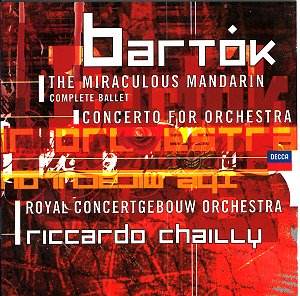
Bartók: Concerto for Orchestra; The Miraculous Mandarin
Royal Concertgebouw Orchestra; Riccardo Chailly, conductor.
Decca 458 841–2. Format, 70:54.
Why Decca sat on this recording for seven years is anybody’s guess—some corporate mystery involving merged catalogs and marketing strategies that defy rational explanation. The delay hardly matters now. What matters is that we have here a Concerto for Orchestra that stands proudly alongside the legendary Reiner performance, different in temperament but equally compelling in its own way.
Chailly and the Concertgebouw approach Bartók’s 1943 masterwork with a kind of aristocratic refinement that never—and this is crucial—slides into mere politesse. The first movement’s opening, those cellos and basses emerging from darkness, has genuine weight. The string sound is warmer than Reiner’s leaner Chicago textures, more burnished, but there’s nothing soft about the rhythmic drive when it arrives. Listen to how cleanly the brass cut through at 3:42 in the first movement, that perfect balance between section and individual voice that only the world’s great orchestras can manage.
The second movement “Game of Pairs” reveals both the strengths and the single reservation I have about this performance. The wind solos are exquisite—the bassoons particularly, with that slightly reedy edge that sounds utterly authentic to Bartók’s folk sources. But those trombone glissandi in the fourth movement are almost too perfect, too refined. I wanted more vulgarity, more of the peasant dance hall. This orchestra plays with such sophistication that even its earthiness has good manners.
Yet the rhythmic security throughout is unshakeable. Chailly understands—really understands—how Bartók’s cross-rhythms need to breathe, how they grow organically from the melodic material rather than being imposed from outside. The Elegia has proper desolation without wallowing; the "finale" erupts with genuine joy. And that famous Shostakovich parody in the “Intermezzo interrotto”? Chailly plays it with just enough mockery, the clarinet’s vulgar tune perfectly judged.
The Miraculous Mandarin that fills out the disc is, if anything, even finer. Here the Concertgebouw’s sophistication becomes an asset—this is, after all, a score of tremendous complexity, and the orchestra navigates its shifting textures with ease that never sounds easy. The opening chase music has real menace; you can hear the mandarin’s supernatural otherness in the way the brass chords hang suspended. When the Laurenscantori Choir enters briefly, their contribution blends seamlessly into the orchestral fabric.
What strikes me most is the sheer sonic clarity of Decca’s engineering. The Concertgebouw’s Grote Zaal can be tricky—too much resonance and everything blurs—but the engineers have captured both warmth and definition. You can follow individual lines even in the densest passages, yet nothing sounds spotlit or artificial. In the mandarin’s final transfiguration, when the music finally achieves its hard-won resolution, the string sound opens up into something genuinely transcendent.
This isn’t quite the last word on either work—Reiner’s Concerto for Orchestra still has that feral energy, that sense of music clawing its way into existence. But it’s a distinguished alternative, beautifully played and recorded. The Concertgebouw remains what it has been for decades: one of the three or four finest orchestras on the planet. That Decca kept this in the vault for seven years seems, in retrospect, almost criminal.
Strongly recommended