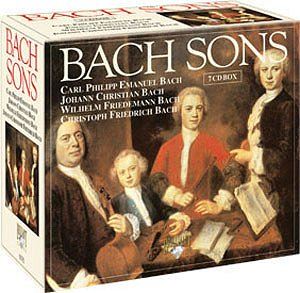
Bach: Berlin Symphonies; Cello Concertos; Flute Concertos; Symphonies; Sinfonie concertanti
Balázs Máté, cello; Machiko Takahashi, flute; Concerto Armonico; Hartmut Haenchen, conductor; Péter Szüts, conductor; Ross Pople, conductor; London Festival Orchestra; Burkhard Glaetzner, conductor; Neues Bachisches Collegium Musicum
Brilliant Classics 93174. Various sessions. 7 discs, 7:28:00
Brilliant Classics has assembled here a sprawling—one might say sprawling to excess—anthology of music by four of Johann Sebastian Bach’s composing sons. Seven discs. Nearly seven and a half hours. The sheer bulk poses a question: does the music justify such thorough treatment, or are we engaging in genealogical piety?
The answer, predictably, is mixed.
Carl Philipp Emanuel emerges as the giant among these siblings, and Hartmut Haenchen’s traversal of the Berlin Symphonies confirms what we’ve suspected since the recent CPE Bach renaissance began gathering momentum. These aren’t provincial curiosities—they’re works of genuine substance, shot through with the kind of harmonic daring and emotional volatility that must have seemed almost shocking in Frederick the Great’s Berlin. The Symphony in E Minor, Wq 178, with its opening "Allegro" assai lunging between forte outbursts and sudden pianissimo withdrawals, sounds decades ahead of its time. Haenchen’s Kammerorchester plays with appropriate urgency, though I wish the strings weren’t quite so thickly upholstered in the lower registers. The winds—particularly the oboes in the E-flat Major Symphony—project with welcome clarity.
The cello concertos offer different pleasures. Balázs Máté plays beautifully, with a singing tone that finds the vocal quality in these long-breathed melodies. Yes, his vibrato is more generous than period practice would allow, and the liner notes’ claim of “authentic instruments” seems—optimistic. But listen to how he shapes the “"Largo" con sordini, mesto” from the A Major Concerto—that mournful second movement with its muted strings creating a veil of sound. Máté understands that CPE Bach’s slow movements aren’t merely decorative interludes but psychological landscapes. The fast movements crackle with energy, even if Concerto Armonico occasionally sounds a bit rough around the edges.
Machiko Takahashi’s flute concertos present CPE Bach in his most galant mode. These are the works of a court composer writing to please, not to challenge—elegant, fluent, sometimes almost Mozartian in their graceful turns of phrase. The D Minor Concerto stands apart, darker and more probing than its companions. Takahashi plays on modern instrument with liquid tone and admirable technical command, though I found myself wishing for more dynamic contrast in the outer movements. The Concertgebouw Chamber Orchestra provides polished accompaniment without generating much electricity.
Then we descend into more problematic territory.
Johann Christian Bach—the “London Bach,” the youngest son who converted to Catholicism and wrote operas in Italy—receives two discs. His symphonies are pleasant. Competent. Utterly predictable. They follow the Mannheim-influenced style with dutiful adherence to convention: a rising forte gesture here, a singing second theme there, a bustling "finale" to send everyone home happy. The G Minor Symphony, op. 6, no. 6, promises something more substantial with its minor-mode opening, but even that work settles into comfortable gestures. Péter Szüts and Concerto Armonico play with spirit, but there’s only so much one can do with music that rarely ventures beyond the formulaic.
The sinfonie concertanti fare slightly better—the form itself demands more variety, more interplay between soloists and orchestra. But these pieces, licensed from ASV and performed by Ross Pople’s London Festival Orchestra, suffer from muddy recorded sound that obscures detail. The Sinfonia Concertante in E-flat for two clarinets and bassoon has genuine charm, the winds conversing like characters in a comedy of manners. Still, one senses Mozart lurking just offstage, ready to show how these same ingredients could yield something transcendent.
Wilhelm Friedemann Bach—the eldest son, the most gifted, the most tragic—commands attention. His so-called “Dissonant” Sinfonia in F Major opens with harmonic clashes that still sound audacious. This is music that refuses to behave, that pushes against the boundaries of mid-eighteenth-century taste. One understands why Wilhelm Friedemann struggled to find steady employment; his music doesn’t aim to please so much as to provoke. Haenchen’s performances capture this restless quality, though the 1993 Berlin disc sounds a bit dry. The Suite in G Minor—long attributed to Johann Sebastian before being reassigned to Wilhelm Friedemann—shows the elder Bach’s influence most directly, particularly in the grave beauty of the “Aria, "adagio".”
Johann Christoph Friedrich Bach, the “Bückeburg Bach,” brings up the rear with three symphonies that show professional competence and little else. Burkhard Glaetzner and the Neues Bachisches Collegium Musicum do what they can, but this is essentially music by a provincial Kapellmeister writing in the approved style of the 1770s and ‘80s. The B-flat Major Symphony has a certain autumnal warmth in its slow movement, but these works would be entirely forgotten if their composer weren’t a Bach.
Which returns us to the essential question: why should we care about the Bach sons? In CPE Bach’s case, the answer is clear—here was a genuinely original voice, a composer who influenced Haydn and Mozart and pointed toward the emotional extremes of the Sturm und Drang. Wilhelm Friedemann, too, deserves attention as a fascinating might-have-been, a composer whose radical impulses were thwarted by circumstance and, perhaps, by his own demons.
The other two? They’re footnotes. Skilled footnotes, but footnotes nonetheless.
Brilliant Classics has done collectors a service by gathering this material in one economical package. The recordings vary in quality—some quite good, others merely serviceable—but none are disastrous. For those curious about the Bach family legacy, this set provides a thorough overview. Just don’t expect seven hours of revelation. Three of those hours—the CPE Bach discs and the Wilhelm Friedemann—are worth having. The rest is for completists and genealogists.