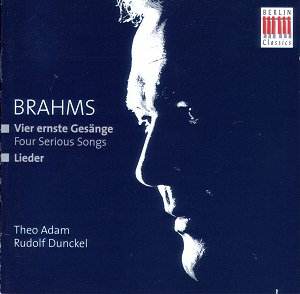
Brahms: Vier Ernste Gesänge; “Sonntag”; “Der Tod, das ist die kühle Nacht”; “Nicht mehr zu dir zu gehen”; “Wie bist du, meine Königin.“
Theo Adam, bass-baritone; Rudolf Dunckel, piano.
Berlin Classics [catalog number not provided]. Recorded 1974, [venue not provided]. Reissue. CD.
The reissue of Theo Adam’s 1974 Brahms recital arrives like a letter from another era—one when bass-baritones still commanded the Lieder stage with something approaching regularity. Adam, whom most of us remember primarily as a monumental Wagnerian (his Sachs at the Met in the early seventies had a granitic authority that younger singers can scarcely imagine), reveals here a more intimate art. But intimate is perhaps the wrong word. Inward, yes. Intimate? Not quite.
The voice itself remains magnificent throughout—a dark-grained instrument with that particular East German solidity, the kind of sound that seems hewn from oak rather than spun from silk. In “Sonntag,” Adam and Rudolf Dunckel catch the folk-song lilt with genuine charm, the bass-baritone caressing “tausend schöne Jungfräulein” with a paternal warmth that feels entirely appropriate to the text. The dance lilt sits comfortably in his voice. Here is singing that understands Brahms’s debt to German vernacular tradition without needing to underline it.
But elsewhere—and this matters considerably—Adam’s interpretive choices lean toward the statuesque when Brahms demands something more volatile, more psychologically fraught. “Der Tod, das ist die kühle Nacht” opens with exquisite tonal placement, that low note on “Tag” resonating with proper darkness. Yet the crucial word “müde” passes without sufficient inflection, and when the lover’s ecstasy erupts at “Liebe,” Adam delivers the notes without quite inhabiting the rapture. It’s the difference between singing about passion and singing from within it.
The problem intensifies in “Nicht mehr zu dir zu gehen,” where Brahms sets Daumer’s text of obsessive, self-destructive longing. Adam phrases it all beautifully—no question of his musicianship—but where Quasthoff (on his DG recording, though you’ll need two discs for the full Brahms survey) finds something genuinely unhinged, Adam remains too centered, too reasonable. “Verlor ich” needs to hurt more than it does here. The psychological temperature stays a degree or two too cool.
I kept thinking of Matthias Goerne’s recent Wigmore Hall performance of this repertoire—not yet captured on disc, more’s the pity—where he and Leif Ove Andsnes seemed to discover these songs anew, phrase by phrase. Adam, for all his virtues, rarely surprises. In “Wie bist du, meine Königin,” his “Wonnevoll!” sounds warmly paternal rather than erotically transported. Dunckel plays the piano part with considerable beauty, though without quite the soulful shading that Justus Zeyen brings to it.
The Vier Ernste Gesänge represents Adam at his most impressive. Here the monumental quality of his voice serves the music rather than constraining it. “O Tod, wie bitter bist du” unfolds with beautifully sustained legato—the breath control of a singer who spent years navigating Wagner’s long phrases. The contrast in “Wenn ich mit Menschen- und mit Engelzungen redete” between swagger and spiritual yearning comes across convincingly, though Fischer-Dieskau finds more gradations of color within individual phrases.
What we have, finally, is singing of real distinction that doesn’t quite achieve transcendence. Adam brings his considerable gifts to this music—the noble voice, the impeccable diction, the musical intelligence—but something essential remains just out of reach. Perhaps it’s temperamental. Some singers can’t help but reveal everything; others maintain a certain reserve even when the music demands exposure.
Dunckel accompanies with sensitivity and precision, though the partnership never quite catches fire. The 1974 recording captures both artists clearly, with minimal resonance—perhaps too dry for some tastes, but it does allow the text to register with unusual clarity.
Berlin Classics provides no texts, which seems miserly for a reissue. The sound itself holds up well enough, though modern ears accustomed to DG’s more spacious acoustic might find it a bit airless.
This disc serves best as a document of a great Wagnerian voice in different repertoire—valuable for that alone. But as a primary recommendation for Brahms’s songs? The competition proves too formidable. Until Goerne records these works (and please, someone convince him to do so), Quasthoff remains the safer choice, despite the inconvenience of multiple discs. Adam’s Brahms commands respect without quite winning the heart.