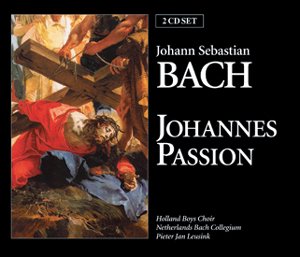
Bach: St. John Passion
Marcel Beekman, tenor; Robert Muuse, bass-baritone; Marjon Strijk, soprano; Bas Ramselaar, bass; Syste Buwalda, alto; Martinus Leusink, tenor; Holland Boys Choir; Netherlands Bach Collegium; Pieter Jan Leusink, conductor.
BIS. Recorded 2000, Grote Kerk. CD.
The problem with Pieter Jan Leusink’s approach to the St. John Passion—and it’s not a small one—is that he seems to have mistaken energy for insight. Fast tempi, certainly. Vigor, yes. But Bach’s most harrowing passion setting demands something beyond mere propulsion.
This is the leaner, more astringent of Bach’s two surviving passions, less than two hours against the St. Matthew Passion‘s near-three. It cuts deeper precisely because it offers less consolation. The violence of the crowd scenes, the theological complexity of Pilate’s interrogation, the stark simplicity of “Es ist vollbracht“—these require not just competent execution but a kind of spiritual reckoning that eludes Leusink’s well-intentioned forces.
Marcel Beekman as the Evangelist is the recording’s chief asset. His tenor has the necessary flexibility and—more crucially—the narrative intelligence to shape Bach’s recitatives as drama rather than mere storytelling. Listen to how he colors the word “weinete” in Peter’s denial scene, that quick darkening of tone. This is a singer who understands that the Evangelist isn’t a neutral reporter but a witness still shaken by what he’s seen.
The choral sound, though, is where things unravel. The Holland Boys Choir—and I say this with real regret, having admired their work elsewhere—sounds hopelessly top-heavy in the great opening chorus. Those swirling string figures, that sense of cosmic tumult Bach creates, all need anchoring from below. What we get instead is a kind of hovering shimmer, attractive enough in its way but fundamentally unbalanced. The smaller chorale settings fare better; when the trebles aren’t being asked to carry such architectural weight, their clear, unaffected tone serves Bach’s hymn settings well.
Syste Buwalda’s alto work is competent—a word I use advisedly. His voice has a pleasant, slightly reedy quality that suits baroque practice, and his “Von den Stricken” shows good control. But I kept wanting more personal investment, more sense that these aren’t just exquisite melodies but prayers wrung from extremity.
The real disappointment is Marjon Strijk in “Zerfließe, mein Herze.” This aria, with its two flutes weaving their lament around the soprano line, should break your heart. Bach wrote it in the shadow of the crucifixion—Mary at the foot of the cross—and it requires a kind of sustained grief that Strijk simply doesn’t deliver. Her tone is pleasant, even boyish as someone once described it, but there’s a thinness to her attack, a lack of emotional weight. The flutes sound lovely in the Grote Kerk’s acoustic, but they’re essentially accompanying an absence.
The instrumental work from the Netherlands Bach Collegium is clean, transparent, and historically informed in all the expected ways. Leusink’s tempi push things along—perhaps too much so in the turba choruses, where the crowd’s fury starts to sound merely hectic rather than terrifying. The continuo playing is alert, though I’d have welcomed more variety in the organ registration during the recitatives.
A word about the documentation: providing only the German text, with no translation, seems almost perversely unhelpful in 2002. Even budget labels can manage better.
This is a serviceable account that gets some things right—Beekman’s Evangelist, the transparency of texture, the commitment if not always the achievement. But the St. John Passion isn’t a work that rewards mere serviceability. Set this beside Suzuki’s disc on BIS, with its perfect balance of scholarly rigor and spiritual depth, and Leusink’s version sounds like a preliminary sketch. At budget price it won’t disappoint casual listeners. But those seeking to really inhabit this dark, magnificent work should look elsewhere.