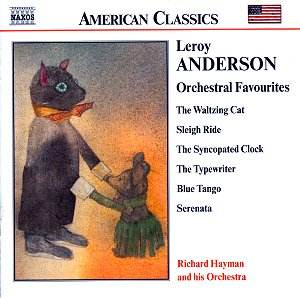
Anderson: Orchestral Favorites
Richard Hayman and His Orchestra
Naxos American Classics 8.559125. Recorded 1989, multiple sessions. CD, 61:22.
There’s something almost perverse about Anderson’s trajectory—Harvard, the New England Conservatory, studies with Enescu and Piston, then this. Not that “this” is negligible. Far from it. But one doesn’t typically emerge from Walter Piston’s tutelage to write “The Waltzing Cat.”
And yet the academic pedigree shows through everywhere, if you’re listening for it. Take “Plink, Plank, Plunk!“—it’s Tchaikovsky’s Fourth Symphony "scherzo" filtered through an American sensibility that prizes wit over portent, brevity over development. Anderson knew exactly what he was doing. The piece lasts barely two minutes, but every pizzicato snap is placed with the precision of a watchmaker. This is craftsmanship of the highest order, even if the Academy wouldn’t deign to notice.
The best of these miniatures—and make no mistake, Anderson was a miniaturist par excellence—operate on multiple levels simultaneously. “Trumpeter’s Lullaby” manages to be both genuinely tender and gently self-mocking, the solo trumpet singing with unaffected lyricism while the orchestration maintains just enough distance to avoid sentimentality. It’s a nuanced balance, and Richard Hayman’s unnamed ensemble (one assumes a crack studio band from the late 1980s) navigates it beautifully. The trumpet soloist—uncredited, regrettably—plays with burnished warmth but never pushes.
“Fiddle Faddle” proves Anderson’s gift for controlled chaos. The piece bubbles and percolates with manic energy, yet the orchestration remains transparent throughout—you can hear every line, every rhythmic gear meshing with its neighbor. This is where that conservatory training pays dividends. Lesser arrangers would have muddied the texture.
I confess “The Typewriter” gave me pause. Hearing it divorced from its usual context as theme music for BBC Radio 4’s News Quiz (a connection I hadn’t made until reading these notes), one appreciates Anderson’s theatrical instincts. The typewriter itself becomes a percussion instrument, integrated into the ensemble rather than simply plunked on top. The bell at the carriage return—perfectly timed, naturally—gets a genuine laugh. When did you last laugh at a piece of orchestral music?
“Blue Tango” remains Anderson’s masterpiece, I think. It was a genuine pop hit in 1952, and one understands why. The piece captures something essential about postwar American optimism—sleek, sophisticated, forward-looking but not aggressively modern. The harmony stays comfortably within tonal bounds, but there’s a chromatic slipperiness in the inner voices that betrays real compositional skill. Hayman’s tempo feels right: not rushed, allowing the tango rhythm to breathe and swing.
The Latin numbers—“Serenata” particularly—benefit from Hayman’s long experience with Arthur Fiedler’s Boston Pops. (Anderson himself arranged for Fiedler starting in 1936, which is where this all began.) There’s an idiomatic ease to the rhythmic inflections, the brass attacks, the marimba colorations. These aren’t musicians faking their way through light repertoire; they’re inhabiting it.
“Sleigh Ride” has been recorded to death, of course. Every shopping mall from Thanksgiving through New Year’s assaults us with it. But Hayman’s 1989 recording—captured, the notes tell us, across several sessions from February through June, which explains the consistently high standard—reminds us that the piece itself is impeccably constructed. Those sleigh bells (genuine sleigh bells, one hopes, not synthesized) enter with perfect timing. The woodwind writing sparkles. And that trumpet solo in the bridge section—again, beautifully played by whoever this is—soars without bombast.
What Anderson understood, and what many “serious” composers of his generation didn’t, was that brevity requires discipline. Not one of these twenty-one pieces exceeds four and a half minutes. Most clock in under three. Yet each establishes its character immediately—often within the first four bars—and then gets on with business. No padding, no meaningless sequences, no vamping while searching for the next idea. Say what you need to say, then stop.
The recorded sound holds up well enough, though the digital remastering (presumably for this Naxos reissue) has added a slight glassiness to the upper strings. The percussion—and Anderson uses percussion brilliantly throughout—comes through with satisfying clarity and impact. Dynamic range seems compressed by modern standards, but this is light music from 1989, not Mahler.
Hayman himself deserves considerable credit. He was Anderson’s friend and colleague, and he conducts this music with obvious affection but zero condescension. The tempos feel natural, never rushed or dragged for effect. Ensemble precision is outstanding throughout. One senses these musicians enjoyed the sessions.
Is this essential listening? That depends on what you consider essential. If you require Austro-German profundity or French impressionist shimmer or even Coplandesque Americana, look elsewhere. But if you can accept music that aims merely to delight—and succeeds brilliantly—then this disc earns its place on your shelf. At bargain price, it’s practically obligatory for anyone interested in American music of the mid-twentieth century.
Anderson knew what he was. He never pretended to write symphonies or string quartets. What he did write, he wrote superbly well. That’s enough.