A Gallic Feast, Inadequately Served
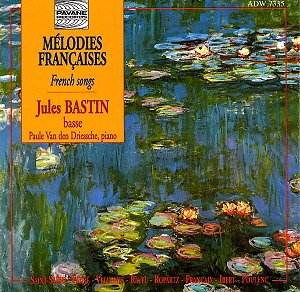
Mélodies Français
Jules Bastin, bass; Paule van den Driessche, piano
Hyperion (originally Pavane ADW 7335) [74:35]
The late Jules Bastin—whose passing in 1996 robbed us of one of the most characterful French-speaking basses of the postwar era—left behind this treasure trove of mélodie, recorded just a year before his death. It’s a recital that sprawls across French song from Saint-Saëns to Poulenc, seventy-four minutes of repertoire ranging from the utterly familiar to the genuinely obscure. And it’s maddening, because Bastin’s artistry deserves better presentation than what Pavane originally provided, and what Hyperion has apparently replicated.
Start with the good news. That voice. Bastin’s instrument had the heft of oak aged in Burgundian cellars—dark, grainy, with a natural warmth that could turn from avuncular humor to genuine pathos without ever sounding calculated. He was fifty-nine when this was recorded, and while there’s an occasional looseness in the upper register (listen to the climax of “Le pas d’armes du Roi Jean”), the interpretive intelligence more than compensates. This is singing that knows the difference between French and German declamation, between the salon and the concert hall.
“Le pas d’armes du Roi Jean” opens the program with all the swagger of a seventeen-year-old Saint-Saëns showing off. Bastin treats it like the period piece it is—romantic medievalism filtered through Hugo’s bombast—and he’s smart enough to wink at us while doing it. The chivalric posturing, the mock-heroic vocal lines soaring over van den Driessche’s galloping accompaniment: it’s Errol Flynn in sound, and Bastin relishes every zig-a-zig-a-zig of the companion piece, the song version of Danse macabre. That xylophonic piano writing, those midnight skeletons cavorting—he milks it shamelessly, and why not?
But then we get Fauré, and everything shifts. Four songs about the sea and departure, and suddenly we’re in a different France entirely. Van den Driessche—who deserves far more credit than these notes provide—catches those subtle maritime swells in “La mer est infinie,” and Bastin’s floating of the vocal line shows a baritonal bass who understood legato. “Diane, Séléné” finds him shaping phrases with genuine tenderness, the kind that comes from decades of living with this repertoire rather than learning it for a album session.
The Vellones songs are new to me. Pierre Vellones (1889–1939)—a name that barely registers even in French song circles—composed five epitaphs that combine Gallic wit with genuine bite. “Épitaphe d’un paresseux” is deliciously lazy in its musical gait; “Épitaphe d’un médecin” turns mordant. Bastin’s comic timing here is impeccable, the slight portamenti suggesting a raised eyebrow rather than sentimentality.
Jean Françaix’s eight Chamfort anecdotes receive similarly alert treatment. These brief character sketches—some barely a minute long—require the kind of verbal dexterity that separates genuine mélodie singers from opera singers slumming in the recital hall. “Le critique” is wonderfully condescending, all pursed lips and superior airs. “Le magistrat suisse” puffs itself up with pompous swagger. Bastin colors each vignette distinctly, though I wish van den Driessche had brought more bite to the piano writing, which can sound almost too polite.
The Ropartz settings of Heine deserve to be better known. These four songs—preoccupied with death without ever turning morbid—show a composer who absorbed both Fauré’s harmonic language and Wagner’s chromatic intensity. “Pourquoi vois-je pâlir” moves from languorous rose imagery to a Dies Irae quotation that van den Driessche integrates with real skill. Bastin rises from whispered intimacy to genuine passion, then subsides into resignation. It’s the kind of through-composed interpretation that reveals years of thought.
Now to the dual Don Quixote settings. When Pabst filmed Cervantes in 1932 with Chaliapin, he commissioned songs from multiple composers. Only Ibert’s were used; Ravel’s Don Quichotte à Dulcinée sat on the shelf. Hearing them back-to-back reveals fascinating contrasts. Ravel’s three songs are more harmonically sophisticated, more subtle in their characterization—the “Chanson romanesque” deploys strategic dissonances to suggest the aging knight’s delusions, while the “Chanson à boire” includes telling hiccups in the piano part. Bastin catches these details beautifully.
But Ibert’s four songs have more immediate theatrical impact, more overt Spanish color. The guitar-like strumming in “Chanson du Duc,” the genuine pathos of “Chanson de la mort de Don Quichotte“—this is music written for a specific voice in a specific dramatic context, and it shows. Bastin doesn’t quite have Chaliapin’s cavernous resonance, but he understands the theatrical gesture these songs require.
The Poulenc that closes the recital finds Bastin in his element. Le Bestiaire offers seven Apollinaire settings, each a miniature character study: the plodding dromedary, the complex gait of the Tibetan goat, the philosophical carp. These are songs Poulenc wrote at twenty-one, already showing his gift for wedding French text to memorable melody. The Chansons gaillardes—bawdy seventeenth-century texts that gave Poulenc license for ribaldry—receive performances that balance sophistication with earthiness. “Madrigal” has that characteristic Poulenc insouciance; “Sérénade” lilts gently while maintaining its sardonic edge.
Van den Driessche throughout proves a sensitive partner, though I occasionally wanted more dynamic contrast, more willingness to dig into the piano’s percussive possibilities. Her touch in the Fauré is lovely, refined without being precious. But in the Poulenc she