
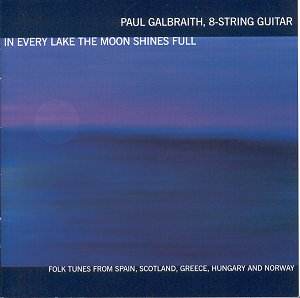
# Folk Tunes Refracted Through Eight Strings
IN: Every Lake The Moon Shines Full**
Folk Tunes from Spain, Scotland, Greece, Hungary and Norway
Joaquín Nin-Culmell: Tonades (on Spanish Folk Tunes), Volume 2
Marjory Kennedy-Fraser: Songs of the Hebrides
Yannis Constantinidis: Miniatures on Greek Folk Tunes
Federico Moreno-Torroba: Aires de la Mancha
Béla Bartók (arr. Szendrei-Karper/Galbraith): “For Children,” Hungarian Folk Tunes, Volume 1
Edvard Grieg: Norwegian Folk Tunes from Op. 66
Paul Galbraith (8-string guitar)
DELOS DE 3236 [61:18]
Paul Galbraith’s eight-string guitar—that curious hybrid instrument developed with the late David Rubio, complete with its cello-like spike and extended range—has always struck me as a solution in search of a problem. Until now, perhaps.
This collection of folk material from five nations makes a case for the instrument’s expanded tonal palette that his Bach recordings never quite managed. The additional treble A and bass C (or low A, depending on the piece) don’t merely add range—they fundamentally alter the guitar’s capacity for sustaining inner voices while melody dances above. In Kennedy-Fraser’s “Songs of the Hebrides,” those Scottish airs originally set for piano, you hear it immediately: the drone strings that evoke bagpipes without mimicry, the way a melodic line can float over sustained harmony that would be impossible on six strings. This isn’t gimmickry. It’s transformation.
Galbraith moves through these fifty-two miniatures—some barely twenty seconds, none exceeding three minutes—with an ethnomusicologist’s sensitivity and a colorist’s instinct. The Nin-Culmell Tonades receive a more refined treatment than Moreno-Torroba’s earthier Aires de la Mancha, and rightly so; Nin-Culmell’s view of Spanish folk tradition is filtered through Parisian sophistication, where Torroba gives you the dust of La Mancha itself. Galbraith understands this distinction. His tone becomes more nasal, more deliberately rustic in the Torroba, while the Nin-Culmell pieces shimmer with that peculiar sheen of folk material viewed through concert-hall windows.
The Grieg selections from Op. 66 bear the composer’s fingerprints so clearly they might as well be Lyric Pieces—which is both observation and mild criticism. These are Grieg’s Norwegian folk tunes, not Norway’s, if you take my meaning. The Bartók, though, presents a different challenge altogether. “For Children” was conceived for piano, and Bartók’s harmonic language, even in these pedagogical pieces, relies on percussive attack and the instrument’s capacity for sudden dynamic shifts. Galbraith’s arrangement (with Szendrei-Karper) compensates through articulation—sharp apoyando attacks that approximate the piano’s bite, judicious use of harmonics to suggest the original’s upper-register glitter.
But it’s the Greek material that surprises most. Yannis Constantinidis remains criminally underrepresented in recordings, and these sixteen miniatures on Greek folk tunes possess a modal ambiguity that the guitar—with its capacity for microtonal bending and its historical association with Mediterranean music—serves beautifully. Galbraith’s phrasing here suggests he’s absorbed something of the rembetiko tradition, that slight elasticity of rhythm, the way a phrase might sigh at its conclusion.
Technical mastery throughout is beyond dispute. The clarity of individual voices in contrapuntal passages, the timbral variety he coaxes from those eight strings, the way he negotiates the perpetual problem of balance in transcriptions—all exemplary. The Delos engineering captures the instrument’s enhanced resonance without exaggerating it, though I could wish for more specificity about album venue and dates beyond the vague “2001?”
I must mention what other critics have noted: Galbraith’s breathing is audible, sometimes distractingly so. It’s the kind of detail that disappears in live rendition but looms large on repeated listening. A small flaw in an otherwise distinguished achievement, but flaw nonetheless.
This disc succeeds where it matters most—in making a convincing argument that folk traditions from wildly different cultures can coexist in a single program without descending into world-music pastiche. The unifying element isn’t just Galbraith’s instrument or his mastery, but his evident respect for each tradition’s distinctive character. He doesn’t flatten these tunes into generic “folklorism.” He honors their differences.
The whole does indeed exceed the sum of its parts, as the original reviewer suggested. But more than that—this represents the most persuasive case yet for Galbraith’s eight-string experiment. The instrument has found its repertoire.
