
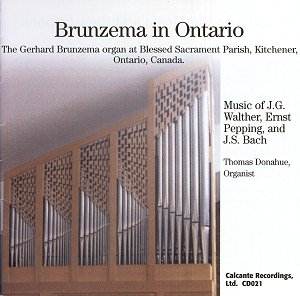
**Thomas Donahue: Chorale Preludes on the Brunzema Organ. / Thomas Donahue, organ. / [Label Catalog Number]. Recorded at Blessed Sacrament Parish, Kitchener, Ontario. CD, [duration].**
Thomas Donahue’s disc of chorale preludes on the Gerhard Brunzema organ at Blessed Sacrament Parish in Kitchener presents us with a curious paradox—an instrument of considerable merit paired with playing that fails to animate it. The disc includes fourteen preludes by Johann Gottfried Walther, selections from Ernst Pepping’s Kleines Orgelbuch, and Bach chorale preludes, some in Donahue’s own transcriptions from the cantatas. The stated purpose: to reveal the Brunzema organ’s tonal resources. Yet demonstration without interpretation makes for thin gruel.
The instrument itself deserves better advocacy. Built in 1991 with a second division added that same year, this mechanical-action organ reflects Brunzema’s commitment to North German baroque traditions—specifically those pre-Schnitger instruments from Groningen and Emden. The specification reveals thoughtful design: a Gedackt 8′ with genuine warmth and body, a Praestant 8′ of notable serenity, a Schwebung 8′ that creates rich undulating textures when paired with the principal. The building’s two-to-three-second reverberation ought to provide ideal acoustic framing.
But here is the rub. Donahue plays as if cataloging stops rather than making music. His touch remains stubbornly uniform throughout, failing to exploit the mechanical action’s responsiveness—that crucial connection between finger and pipe that allows articulation to shape phrase and character. In Walther’s “Wachtet auf, ruft uns die Stimme,” the imitative entries blur together where they should emerge with conversational clarity. The Holzgedackt 8′ produces muddy bass lines because Donahue sustains notes fully rather than varying his attack and release. Any competent organist knows that mechanical action rewards—demands, really—a more nuanced approach.
The Walther preludes suffer particularly. These are sophisticated pieces, their counterpoint as intricate as anything Bach wrote, their harmonic language often surprisingly pungent. Walther wasn’t merely Bach’s friend and distant cousin; he was a formidable composer whose lexicon of 1732 established him as one of the era’s keenest musical minds. Yet Donahue renders these miniatures with academic blandness, all correct notes and zero imagination. Where is the rhetorical shape? The sense of chorale melody as cantus firmus supporting inventive elaboration?
Pepping’s contributions fare no better. These 1940 works represent German neo-baroque style at its most austere and authoritative—think Hindemith’s contrapuntal rigor filtered through chorale tradition. “Vom Himmel hoch, da komm ich her” should have granite-like strength; instead it sounds merely dutiful. Donahue’s square rhythmic approach flattens Pepping’s energetic writing into something closer to a metronome exercise.
Then there are the Bach transcriptions. Why? With the entire Clavierübung III available—music actually written for this type of instrument—Donahue gives us his arrangements from Cantatas 95, 159, and 80. Some transcriptions work: “Ein feste Burg ist unser Gott” translates reasonably well, though the performance itself lacks drama. But “Ich will hier bei dir stehen” confuses the ear by registering the solo line and accompaniment with similar flute colors. No differentiation, no clarity of texture. “Liebster Jesu, wir sind hier” (BWV 731, not a transcription) receives oddly romantic treatment—strange for this organ, stranger still for the style.
The liner notes compound matters. We get exhaustive registration lists—valuable for organists, perhaps—but almost nothing about the composers. Walther and Pepping deserve better than a passing mention of “German composers” working with “German hymn tunes.” Context matters. These pieces emerge from specific theological and musical traditions that illuminate their construction and purpose.
Technical issues mar several tracks. Audible slips that should have been re-recorded, clipped phrase endings where the music demands gentle releases, awkward voice leading in the contrapuntal passages. And those repeated performances with different registrations? They reveal the organ’s colors, yes, but also expose the interpretive monotony. Hearing the same piece twice emphasizes that registration alone doesn’t make music interesting.
The Vallotti temperament—with its six narrow fifths and pure remainders—suits this repertoire well enough, though one wonders whether a more historically appropriate tuning might have served the Walther better. Still, temperament is the least of this recording’s concerns.
What disappoints most is the missed opportunity. The Brunzema organ clearly possesses character and quality. Those upper-work combinations—the Oktave 2′ and Flöte 2′ without shrillness, the Trompete 8′ with its fine voicing—suggest an instrument capable of considerable eloquence. But eloquence requires an advocate who listens, who shapes phrases with purpose, who understands that mechanical action is a tool for musical expression and not merely a historical detail.
This disc will interest organ builders and perhaps those studying Brunzema’s work. As music-making, though, it remains stubbornly earthbound—a catalog masquerading as art.
Richard Dyer
