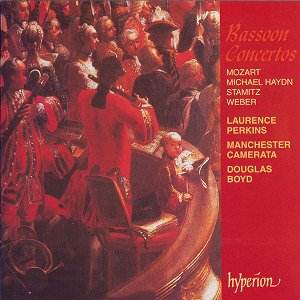
Lawrence Perkins wants you to fall in love with the bassoon. Fair enough—though one suspects the instrument’s cause needs less advocacy than he imagines. Still, there is something touching about his missionary zeal, evident not just in the playing here but in the sleeve notes he has penned himself, gently informative and occasionally bordering on the apologetic.
The program itself is cannily assembled. Mozart’s Concerto in B♭, K. 191, serves as the lure—a Trojan horse, as the original reviewer aptly put it. Written when Mozart was eighteen and already beyond precocious, it remains the Mount Everest of the bassoon repertoire, gregarious in its outer movements, sublime in its "Andante". Perkins plays it with technical polish and good taste, both virtues that do not quite add up to magic. The articulation is crisp, the phrasing considered. But there is a certain fussiness in the first movement’s tempo fluctuations—especially during the passage work—that feels overly cautious. And in that glorious slow movement, where Mozart inches toward operatic abandon (one can almost hear the Countess’s lament hovering nearby), Perkins remains—well, a bit too much the gentleman bassoonist. Not enough diva.
One keeps thinking of Valeri Popov’s reedy intensity on Chandos, or Maurice Allard’s plummy elegance in that long-vanished Deutsche Grammophon disc. Perkins occupies the reedier end of the timbral spectrum—very much to this reviewer’s taste, actually—but he does not quite let the instrument sing its heart out.
Where this disc truly catches fire is in the rarities. Michael Haydn’s Concertino in B♭ (Perger 52/5) is a trifle, admittedly, but Perkins lavishes attention on it as though it were a Brahms sonata. The music shines. Better still is Karl Stamitz’s Concerto in F, a work that deserves far wider currency. Here is early Classical style at its most dramatically alert—the Mannheim orchestra’s influence palpable in every bar. Perkins attacks the articulated passages with real gusto, and suddenly the evangelism pays off. This is stylish playing that makes a case for neglected repertoire without special pleading.
The Weber works—the Andante e Rondo Ungarese and the Concerto in F, op. 75—benefit from Perkins’s textual scholarship. He has assembled a new Urtext edition, and the results are audibly cleaner than some versions one has heard. The playing is polished throughout, though one wishes he had unleashed more theatrical bravura in the "Rondo"’s conclusion. Weber wrote for the stage, after all. This is showpiece music, and while Perkins is lyrical where it should be and forthright when called for, he could afford to be more unabashedly virtuosic.
Douglas Boyd and the Manchester Camerata provide exemplary support—modern instruments played with historically informed sensibility. The high horns in the Mozart’s opening are perfectly judged; the trumpet flourish at the Weber’s close is spot on. This is chamber music making of real intimacy, a genuine collaboration rather than soloist-plus-accompaniment.
So: a mixed success, then, but the successes matter more than the reservations. The Mozart may not dislodge favored versions, but the Stamitz alone justifies the purchase, and Perkins’s advocacy for his instrument—earnest, knowledgeable, occasionally too cautious—ultimately wins the day. The bassoon deserves such champions, even if they are sometimes too polite for their own good.