
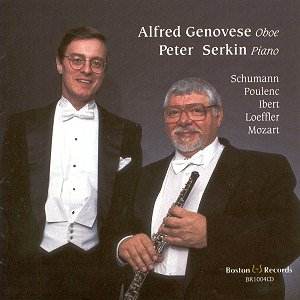
**Genovese: Oboe Recital**
Alfred Genovese, oboe; Peter Serkin, piano; Robert Spano, piano; Burton Fine, viola; Harold Wright, clarinet; Richard Sebring, horn; Richard Svoboda, bassoon. Boston Records BR1004CD. Recorded August 1992, South Mountain Concert Hall. CD, 71:26.
Alfred Genovese earned his reputation as principal oboist of the Boston Symphony through refined musicianship rather than flashy virtuosity—a quality that serves him well in much of this repertoire but leaves certain works wanting something more assertive. This disc, recorded at South Mountain Concert Hall in August 1992, captures an artist at mid-career with all the technical command one expects from a major orchestra’s principal chair. Whether it captures him at his most compelling is another question entirely.
The programming creates immediate problems. Schumann’s Three Romances unfold in a predominantly lyric vein—three movements that barely quicken the pulse—and Poulenc’s Oboe Sonata opens with its Élégie, a movement of considerable gravity and restraint. Nearly twenty minutes pass before we encounter music of genuine animation. For an oboist whose natural temperament runs toward the contemplative rather than the extroverted, this sequence proves perilous.
Genovese’s tone is consistently luminous, centered without being obtrusive, shaped with intelligence. In the Schumann he phrases with genuine sensitivity to the composer’s characteristic blend of tenderness and yearning. But there’s a certain reticence here—an unwillingness to really dig into the emotional core of these pieces. The second Romance wants more ardor; the third needs greater urgency in its syncopated passages. Peter Serkin, a pianist rarely guilty of superficiality, sounds oddly heavy in these pieces, though I suspect the disc balance bears much of the blame. He’s placed too close to the microphones, lending his touch an almost percussive quality foreign to his actual playing.
The Poulenc fares somewhat better. Genovese clearly understands this music’s peculiar mixture of solemnity and wit—the way Poulenc can shift from Prokofiev-like motor rhythms to passages of almost ecclesiastical gravity. The Déploration second movement receives playing of genuine pathos, though again one wishes for more abandon in the "finale"’s jazzy episodes. This is music that benefits from a certain Gallic insouciance, a quality not naturally Genovese’s.
Charles Martin Loeffler remains a fascinating figure—an Alsatian who became Boston’s most distinguished composer in the early twentieth century, a violist in the BSO who absorbed influences from Debussy and medieval music with equal enthusiasm. His Two Rhapsodies for the unusual combination of oboe, viola, and piano date from 1905, products of his most adventurous period. They’re odd pieces, frankly. Loeffler seems uncertain whether he’s writing chamber music or orchestral miniatures reduced for three players. The textures rarely exploit the potential timbral alchemy of these instruments—Burton Fine’s viola might be any string instrument, Spano’s piano any keyboard. One hears craftsmanship without real inspiration, though Genovese and his colleagues perform with conviction.
Now, about that cricket. Yes, there’s an actual cricket chirping away in the background, particularly audible during the quieter passages. It’s maddening. One assumes South Mountain’s windows were open on what must have been a warm August evening, and while I appreciate the desire for natural acoustics, this particular natural element proves an unwelcome soloist. Combined with considerable reed noise from Genovese’s instrument—the kind of mechanical clicking and breathing sounds that disappear in orchestral contexts but loom large in close-miked solo recordings—the sonic picture becomes genuinely distracting.
The engineering presents other challenges. Wind instruments, particularly double reeds, project sound in complex patterns—not primarily from the bell but from whatever tone holes happen to be open at any given moment, creating constantly shifting acoustical patterns that bedevil recording engineers. Here the solution seems to have been placing Genovese at some distance, which robs his playing of presence and immediacy. Subtleties of articulation and color that undoubtedly registered in the hall simply don’t translate to disc.
All of which makes the Mozart Quintet in E-flat for Piano and Winds, K. 452—one of the composer’s most perfectly realized chamber works—the disc’s salvation. Here the ensemble playing takes center stage, and what an ensemble it is: Wright’s clarinet singing with that inimitable Boston Symphony warmth, Sebring’s horn negotiating Mozart’s treacherous writing with aplomb, Svoboda’s bassoon providing exactly the right foundation. This is wind playing of genuine distinction.
Serkin’s contribution remains problematic. His introduction sounds curiously earthbound, lacking the playfulness Mozart surely intended. Where he should sparkle, he plods; where he might toss off a phrase with elegant insouciance, he sounds determined to make a point. But once the Larghetto arrives, his more serious approach begins to make sense—this is genuinely affecting playing, thoughtful without being precious. And the "finale" finds all five players in splendid form, tossing phrases back and forth with evident pleasure.
Genovese himself plays beautifully throughout the Mozart, his tone blending seamlessly with his colleagues while emerging with clarity when the music demands. This is chamber music playing of real maturity—listening as much as leading, responding to harmonic nuance, shaping phrases within the larger architectural design. One wishes the entire disc had maintained this level of engagement.
The question, then: does this recording merit acquisition? For admirers of Genovese’s artistry, certainly. For those building a library of oboe recordings, probably not—superior performances of the Schumann and Poulenc exist in abundance, and the Loeffler, while rare, isn’t rare for particularly compelling reasons. The Mozart is very fine indeed, but it competes with legendary recordings stretching back decades. That leaves us with a disc that documents accomplished musicianship without quite achieving the interpretive distinction that transforms documentation into revelation. A pity, because the potential was clearly there—you can hear it flickering to life in the Mozart’s "finale", when technical mastery and musical imagination finally converge. But too much of what precedes that moment feels merely dutiful, and in an art form where
