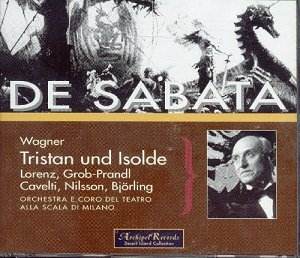
Wagner: Tristan und Isolde**
Grob-Prandl, Lorenz, Cavelti, Bjorling, Nilsson; La Scala Orchestra and Chorus/de Sabata
Archipel ARPCD 0027–3 (3 CDs)
This is dangerous music-making. Reckless, even.
Victor de Sabata’s 1951 La Scala Tristan has circulated among collectors for decades—appearing briefly on LP in 1978, vanishing, resurfacing on CD in 1989, vanishing again. Now Archipel has restored it to the catalogue, and one understands immediately why it exercises such a hold on those who know it. This is conducting that abandons all caution, that treats Wagner’s score not as a sacred text but as raw material for something close to spontaneous combustion. Whether that constitutes great Wagner conducting is another matter entirely.
The sound is atrocious. Let’s be clear about that from the start. This is 1951 La Scala live disc at its most primitive—voices receding into cavernous distance, orchestral balances lurching unpredictably, a general sonic fog that requires the listener to supply what the microphones failed to capture. You need tolerance, considerable tolerance, to get past these limitations. But get past them you must, because what de Sabata achieves here exists nowhere else on records.
His approach to the Prelude establishes everything that follows. Where Bernstein (in that extraordinary Bavarian Radio performance) dares to play the music exactly as Wagner wrote it—holding an unwavering tempo through that immense chromatic ascent, letting the harmony itself generate the tension—de Sabata builds an unwritten accelerando from bar 72 onwards, surging toward the climax with an almost physical force. It’s the approach that Böhm adopted, that Karajan knew, that most conductors have taken for granted as traditional. Karl Böhm supposedly told Bernstein, “You dare to play this music as Wagner wrote it“—the implication being that everyone else, de Sabata included, had been taking liberties for generations.
And what liberties they are. The entire performance has this quality of barely controlled wildness, as if the music might at any moment fly apart into chaos. Act I moves with extraordinary fluidity—de Sabata pushes forward with an urgency that gives Isolde’s fury a present-tense immediacy. Gertrud Grob-Prandl, who sang a magnificent Brünnhilde in the 1949 Vienna Ring under Moralt (still available on Gebhardt, still worth hearing), brings a younger, fresher voice to the role than Flagstad’s granite monumentality. There’s petulance in her “Mir erkoren, mir verloren,” a sense of wounded pride rather than metaphysical despair. When she delivers the curse, she turns dogmatic—phlegmatic, even—where one wants more inwardness, more mystery.
Max Lorenz was fifty-two when this performance took place, his voice showing wear but his dramatic instincts undiminished. He and Grob-Prandl face their greatest challenge in Act II, which de Sabata takes at speeds that border on the hallucinatory. The love duet becomes a kind of ecstatic delirium—breathtaking in its headlong passion, but architecturally almost incoherent. Wagner’s careful structural balances, the way the music circles back on itself in ever-intensifying spirals, gets flattened into a single sustained rush of sound. The singers are dissolved into the orchestral maelstrom, their words often indistinct, their phrases cut short by the sheer velocity of de Sabata’s conception.
And the cuts. God, the cuts. This is by far the shortest Act II on records—shorter even than it would be at these tempos without the excisions. De Sabata removes great swaths of the “O sink hernieder” duet, eliminates most of King Marke’s reproach (poor Sven Nilsson gets to sing perhaps a third of what Wagner wrote), and generally treats the score as if it were twenty minutes too long. By comparison, Böhm at Orange makes only the standard cut in scene 2. One could argue that Wagner’s operas often benefit from judicious trimming—I’ve sat through uncut Parsifals that felt like endurance tests—but here the surgery damages the dramatic logic. We lose the scene’s gradual deepening, its movement from erotic ecstasy toward metaphysical dissolution.
Act III is where everything comes together—or rather, where the interpretation’s extremism finally finds its ideal subject. The opening orchestral prelude achieves a tragic desolation that I’ve encountered nowhere else on records. De Sabata shapes those stark, angular phrases with a sense of utter hopelessness, the woodwind solos emerging from the texture like memories of a world that no longer exists. When Lorenz begins his delirium, he reaches heights of rage and madness comparable to Jon Vickers on Karajan’s studio recording (itself a problematic achievement, that Karajan—magnificent orchestral playing in service of a fundamentally misconceived approach).
The shepherd’s pipe sounds from some impossibly distant place. Kurwenal’s anguish—Siegurd Bjorling sings with rough-hewn directness—takes on an almost unbearable poignancy. And when Isolde finally arrives, the “Liebestod” that Grob-Prandl delivers has a quality of hard-won transcendence, earned through all the previous extremity. De Sabata doesn’t sentimentalize the ending; he shapes it with the same structural rigor he brought to his 1938 Berlin Philharmonic recording of the Prelude, building to a climax that feels genuinely cathartic rather than merely luminous.
Celibidache, who sneaked into de Sabata’s rehearsals at La Scala, clearly absorbed this approach—though his own recording of the Prelude (there’s only one) adopts a slower tempo while maintaining that same sense of symmetrical architecture, that same surging inevitability toward the climax. The influence runs through postwar Italian conducting like an underground river.
Is this the greatest Tristan on records? No. That distinction probably belongs to Böhm’s 1973 Orange performance, or possibly to the 1948 Erich Kleiber (which I’ll discuss in next month’s survey). But “greatest” isn’t always the relevant category. This de Sabata is indispensable precisely because it exists at