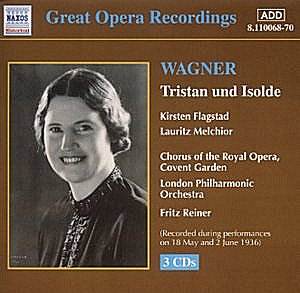
WAGNER: Tristan und Isolde**
Kirsten Flagstad (Isolde), Lauritz Melchior (Tristan), Sabine Kalter (Brangäne), Herbert Janssen (Kurwenal), Emmanuel List (King Marke), Frank Sale (Melot), Roy Devereux (Sailor), Octave Dua (Shepherd), Leslie Horseman (Steersman)
Chorus of the Royal Opera House, Covent Garden
London Philharmonic Orchestra / Fritz Reiner
Recorded at Covent Garden, May 18 and June 2, 1936
NAXOS HISTORICAL 8.110068–70 [3 CDs: 209:29]—This is one of those recordings that makes you stop fretting about sonic limitations and remember what singing actually was.
May 1936. The London Philharmonic under Beecham’s directorship was still fresh, brilliant, only three years old. Reiner—young, ferociously intelligent—was making one of his rare appearances in the Covent Garden pit. And Flagstad and Melchior were in the middle of their six brief seasons together, that partnership which has haunted every subsequent Tristan like an unattainable ideal. The engineers ran two turntables in tandem to capture the performance on fifty-two 78rpm sides. Primitive, yes. But what they caught…
Reiner’s conducting here ought to be placed alongside any discussion of Furtwängler’s way with this score. Where Furtwängler seeks cosmic sweep and metaphysical weight, Reiner—and this is the revelation—finds an almost chamber-like intimacy in Wagner’s densest textures. The Act II love duet has passages where the orchestral writing seems to prefigure Schoenberg’s Verklärte Nacht, all that late-romantic chromaticism turned inward, whispered rather than proclaimed. Leon Goossens’s oboe in the Shepherd’s tune: heartbreaking in its simplicity. Bernard Walton’s clarinet threading through the Act III delirium with surgical precision.
The London Philharmonic plays for Reiner with an intensity I’m not sure they ever quite matched for Beecham in this work. Every detail is etched. Nothing is generalized. And yet—here’s the paradox—nothing feels fussy or over-controlled. The great surges in the Prelude and Liebestod have genuine abandon. Reiner somehow manages to be both microscopically attentive and swept up in Wagner’s erotic mysticism.
About Flagstad and Melchior: what’s left to say? The vocal beauty is beyond dispute—that much is obvious even through the sonic scrim. But listen to the words. In the love duet especially, both singers are acting with consonants and vowels, not just pouring out gorgeous tone. When did we lose this? Flagstad’s “Isolde” at “So stürben wir, um ungetrennt” has such specificity of inflection that you hear her mind working, not just her voice. And Melchior’s Act III delirium—that terrifying descent into madness—is built phrase by phrase with a theatrical intelligence that puts most modern Heldentenors to shame.
Melchior’s stamina remains incomprehensible. By the end of Act III he’s still singing with the same bronze gleam, the same ease in the passaggio, that he commanded in Act I. No barking, no pushing, no desperation. Just that inexhaustible stream of tone. Flagstad matches him—her Liebestod here may lack some of the sculptural grandeur she brought to Furtwängler’s studio release fifteen years later, but there’s a rawness, an immediacy, that’s utterly compelling. You hear a woman who’s been through the entire evening, who’s earned this transfiguration.
The supporting cast is uneven. Herbert Janssen’s Kurwenal has authority and a certain blunt nobility. Sabine Kalter as Brangäne sounds appropriately spectral in her offstage warnings—though I wish she had more tonal sheen in Act I. Emmanuel List’s King Marke is dignified but rather generalized; you don’t feel the personal anguish cutting through. The smaller roles are forgettable, and the chorus sounds threadbare and underrehearsed. One suspects they were accustomed to Beecham’s more relaxed standards.
Ward Marston’s transfer captures as much as these test pressings will yield. There’s inevitable surface noise, some pre-echo, momentary distortion in the loudest climaxes. But the voices are present, the orchestral balances make sense, and—crucially—Marston hasn’t tried to over-process the sound into some artificial semblance of modernity. This is 1936, and it sounds like 1936. Accept that, and you’ll find the performance burns through the sonic limitations.
One curiosity: the Act I Prelude comes from the June 2 reading, while the rest is from May 18. Apparently the May Prelude was unusable. During the June recording, Flagstad’s warm-up vocalises in the wings were faintly picked up by the microphones—an endearing accident that reminds you this was a living event, not a studio construction.
The traditional cut in the love duet will bother purists. It bothered me once. But Haitink was still making the same cut at Covent Garden in 2001, and somehow when you’re in the grip of singing like this, the issue feels pedantic.
For modern sound, Böhm’s DG set with Nilsson and Windgassen remains indispensable—that’s probably the most completely satisfying Tristan on records. Furtwängler’s 1952 EMI studio recording with Flagstad and Suthaus has better mono sound than this Naxos issue and Furtwängler’s incomparable orchestral palette, though Suthaus is no match for Melchior. But this 1936 document—crude as the sonics are—captures something irreplaceable: two legendary voices at their absolute peak, an orchestra playing at white heat, and a maestro who understood this score as profoundly as anyone who ever held the baton.
Some nights at the opera transcend their moment. This was one of them.