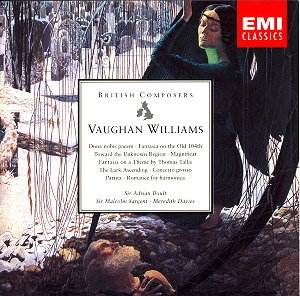
Vaughan Williams: Orchestral and Choral Works
EMI Classics CZS 5 74782 2 (2 CDs)
Sheila Armstrong, soprano; Helen Watts, contralto; John Carol Case, baritone; Peter Katin, piano; Jean Pougnet, violin; Larry Adler, harmonica; London Philharmonic Choir and Orchestra, BBC Symphony Orchestra, Philharmonia Orchestra; Sir Adrian Boult, Sir Malcolm Sargent, Meredith Davies
Here’s a peculiar beast—two discs crammed with Vaughan Williams that nobody asked for in quite this configuration, yet which illuminate corners of his output we’ve been content to ignore while recycling the Tallis Fantasia for the umpteenth time. EMI has assembled a grab-bag spanning 1952 to 1975, mixing the inevitable with the genuinely obscure, and the results are… well, uneven doesn’t quite capture it. Maddening? Revelatory? Both, depending where you drop the needle.
The first disc tilts heavily toward the vocal works, and here’s where EMI’s parochialism becomes genuinely irritating. No texts. Not a syllable printed for Toward the Unknown Region, Dona nobis pacem, the Magnificat, or the Psalm Tune Fantasia. One assumes the good burghers at EMI imagine that native English speakers will catch every word of Whitman through the choral wash—a fantasy I’d pay good money to witness. This is music meant to speak across borders, yet the presentation screams “for domestic consumption only,” as if Vaughan Williams were some quaint regionalist rather than a composer wrestling with Whitman’s cosmic humanism and the bloodstained aftermath of two world wars.
Toward the Unknown Region (1907) remains apprentice work, competent Stanford-and-Parry with a dash of daring in its choice of text. Boult’s 1973 recording sounds oddly distracted in the opening pages—he was eighty-four by then, and one senses a director going through familiar motions until the second half’s passion finally kindles his interest. The release itself scatters forces across Kingsway Hall in a way that robs the climaxes of impact. Yet even half-engaged, Boult understands the long paragraph in ways few conductors born after 1940 seem to grasp.
But Dona nobis pacem—here’s where everything coheres into something overwhelming. Recorded at those same 1973 sessions, this performance burns with an urgency that transcends its dated sonics. Boult, Sheila Armstrong’s gleaming soprano cutting through the texture like a sword, John Carol Case’s baritone carrying Whitman’s terrible compassion (“For my enemy is dead, a man as divine as myself”)—they’re not performing, they’re testifying. This is the visionary Vaughan Williams, the one who saw through nationalism’s seductions to something harder and more necessary. The 1936 score mingles Latin liturgy with Whitman in ways that anticipate Britten’s War Requiem by a quarter-century, and this rendition makes that genealogy audible. Essential listening, worth the price alone.
The Magnificat (1932) remains a thorny proposition. Helen Watts navigates its agnostic humanizing of the Annunciation with her customary intelligence, Christopher Hyde-Smith’s flute adding its astringent commentary, but the piece itself—female voices, solo contralto, flute, small orchestra—feels more admirable than lovable. Meredith Davies conducts with clarity, yet one emerges respecting the craft more than cherishing the result. Stanford’s G major setting, with its spinning-wheel accompaniment, lodged itself in the Anglican bloodstream; Vaughan Williams’s version remains stubbornly outside, looking in.
The Fantasia on the Old 104th Psalm Tune (1949) for piano, chorus, and orchestra is vintage late Vaughan Williams: cussedly individual, blithely indifferent to Beethoven’s demonstration that such combinations don’t quite work. Peter Katin plays with authority, Boult marshals the forces with conviction earned from the 1950 premiere, and the result is… odd. Disarmingly odd. The composer was seventy-seven, still experimenting, still refusing to repeat himself. One has to admire it even while recognizing it’s nobody’s favorite.
The second disc shifts to orchestral territory, and here the programming choices grow more puzzling. The Partita (1948, though it began life as a 1938 double string trio) strikes me as Vaughan Williams in his least interesting Hindemithian mode—well-wrought gebrauchsmusik from thematic material that never quite catches fire. Michael Kennedy’s program note hopefully invokes “Stravinskyan rhythmic devices,” which is critic-speak for “this sounds a bit mechanical.” Boult, who led the premiere, can’t quite convince me there’s more here than competent craft. The “Homage to Henry Hall” movement winks at the BBC Dance Orchestra conductor, but the joke has aged poorly.
The Concerto Grosso (1950), written for the Rural Music Schools Association to let students play alongside professionals, fares better—more warmth, more genuine melodic impulse. Still, these later string works feel dutiful next to what follows.
Because Sargent’s 1959 Tallis Fantasia sits right there, and it’s all wrong. Oh, it’s pleasant enough, beautifully played by the Philharmonia at St. Augustine’s, Kilburn, with that trademark EMI glow. But Sargent hears only the surface—it “babbles of green fields” without grasping the stark, Hardyesque tragedy beneath. If EMI still controls those Westminster masters (and they used to), why not give us Boult’s Vienna recording from the same year? Teaching the responsive Vienna State Opera Orchestra this music, he found sharper edges, a more etched quality. Or his 1975 version, where an eighty-six-year-old conductor revisits the 1910 score as time-traveler, evoking a vanished world without sentimentality, every crescendo and accelerando placed exactly where Vaughan Williams wrote it. Either would have served this music—and this compilation—far better.
The Romance in D-flat for harmonica and orchestra (1951) is Larry Adler’s show, recorded a month after the Proms premiere. The sound is frankly